The Cloud Is Not a Cloud
AI may feel weightless on a screen, but the future has a physical address.
By Chris Markl
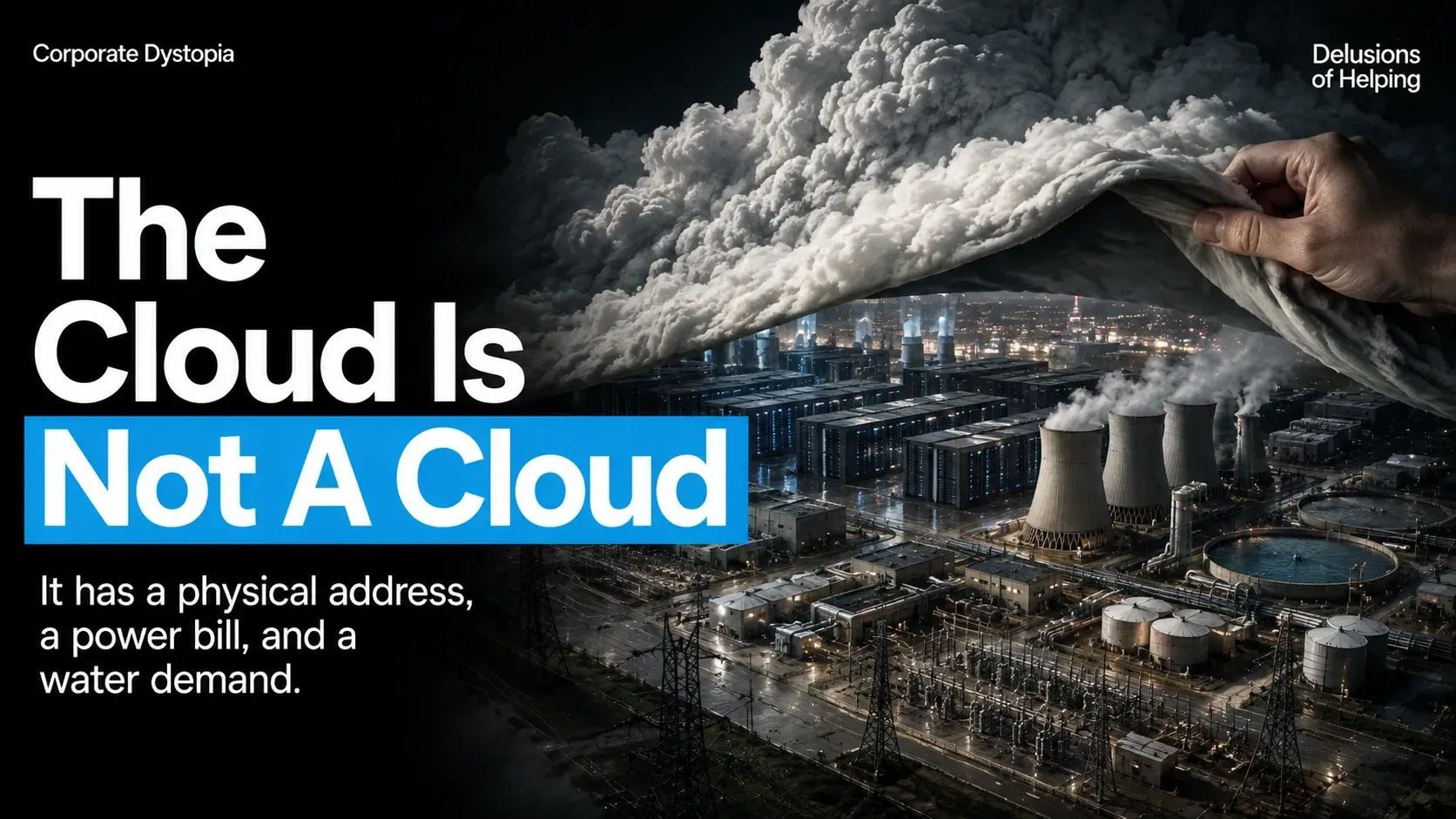
The cloud is not a cloud.
It is land.
It is steel.
It is concrete.
It is electricity.
It is water.
It is fiber.
It is transmission.
It is cooling.
It is substations.
It is backup power.
It is tax incentives.
It is zoning.
It is permitting.
It is local politics.
It is regional infrastructure.
It is a massive physical system hidden behind a soft metaphor.
That metaphor matters.
Cloud sounds weightless. Clean. Floating. Natural. Borderless. Harmless. Almost magical.
But the digital world is not magic.
AI does not live in the sky.
Your files do not sleep in mist.
The internet is not an invisible blessing delivered by vibes.
Modern technology depends on physical infrastructure. As artificial intelligence expands, that infrastructure becomes more demanding, more expensive, more visible, and more politically important.
This is where the AI future becomes real.
Not in the keynote.
Not in the demo.
Not in the promotional video about democratizing intelligence.
In the community deciding whether to approve another data center.
Corporate Dystopia does not mean technology is bad. That would be lazy. Technology can help. Data centers can matter. AI may produce enormous value. Broadband can connect people to work, education, health care, services, markets, and opportunity. Digital infrastructure is now part of economic life.
The problem is not the existence of infrastructure.
The problem is the helping claim.
Tech companies do not merely say they need power, land, water, and public cooperation.
They say they are building the future.
They say they are expanding opportunity.
They say they are accelerating innovation.
They say they are helping communities participate in the digital economy.
Maybe.
Fine.
Prove it.
A data center can be necessary infrastructure and still be a bad local deal.
A project can support AI and still strain the grid.
A company can create tax revenue and still receive excessive incentives.
A facility can create jobs and still produce fewer durable local benefits than promised.
A campus can increase regional prestige and still raise serious questions about water, energy, land use, noise, opportunity cost, and ratepayer protection.
A technology can be powerful and still concentrate power.
The question is not whether the cloud is useful.
The question is who pays for making it physical.
When a company wants to build, communities should ask a better set of questions.
Will the project pay the full cost of the infrastructure it requires?
Will ratepayers be protected?
Will the grid become stronger, or merely more burdened?
Will water use be responsible?
Will the tax base improve after incentives are counted?
Will local workers benefit?
Will local suppliers participate?
Will the community gain skills, programs, infrastructure, or long term opportunity?
Will public agencies have the capacity to negotiate and monitor the deal?
Will the project strengthen the place, or simply use the place?
These questions are not anti technology.
They are pro reality.
The AI industry loves abstraction. Models. Compute. Intelligence. Automation. Productivity. Transformation. Acceleration.
Communities live with specifics.
A road has to carry trucks.
A substation has to be built.
A utility has to plan load.
A water system has limits.
A planning commission has to approve land use.
A neighborhood has concerns.
A state may offer incentives.
A county may expect revenue.
A workforce system may or may not be ready.
The corporate story is global.
The consequences are local.
That is why local governments need to stop treating technology projects like gifts from the future.
They are deals.
Some deals are good.
Some are bad.
Most are complicated.
But they should all be judged by public value.
Did the project help?
Did it help efficiently?
Did it help enough?
Did it help more than it harmed?
Could the same land, power, water, incentives, attention, or infrastructure have helped the community more another way?
Those are the right questions.
Not because AI is fake.
Because AI is real enough to deserve serious scrutiny.
A weak community says yes because the company is famous.
A scared community says no because the technology sounds threatening.
A serious community says show us the terms.
That is the standard.
The cloud is not a cloud.
It is a physical bargain.
And if the bargain is being sold as helping, the public deserves receipts.