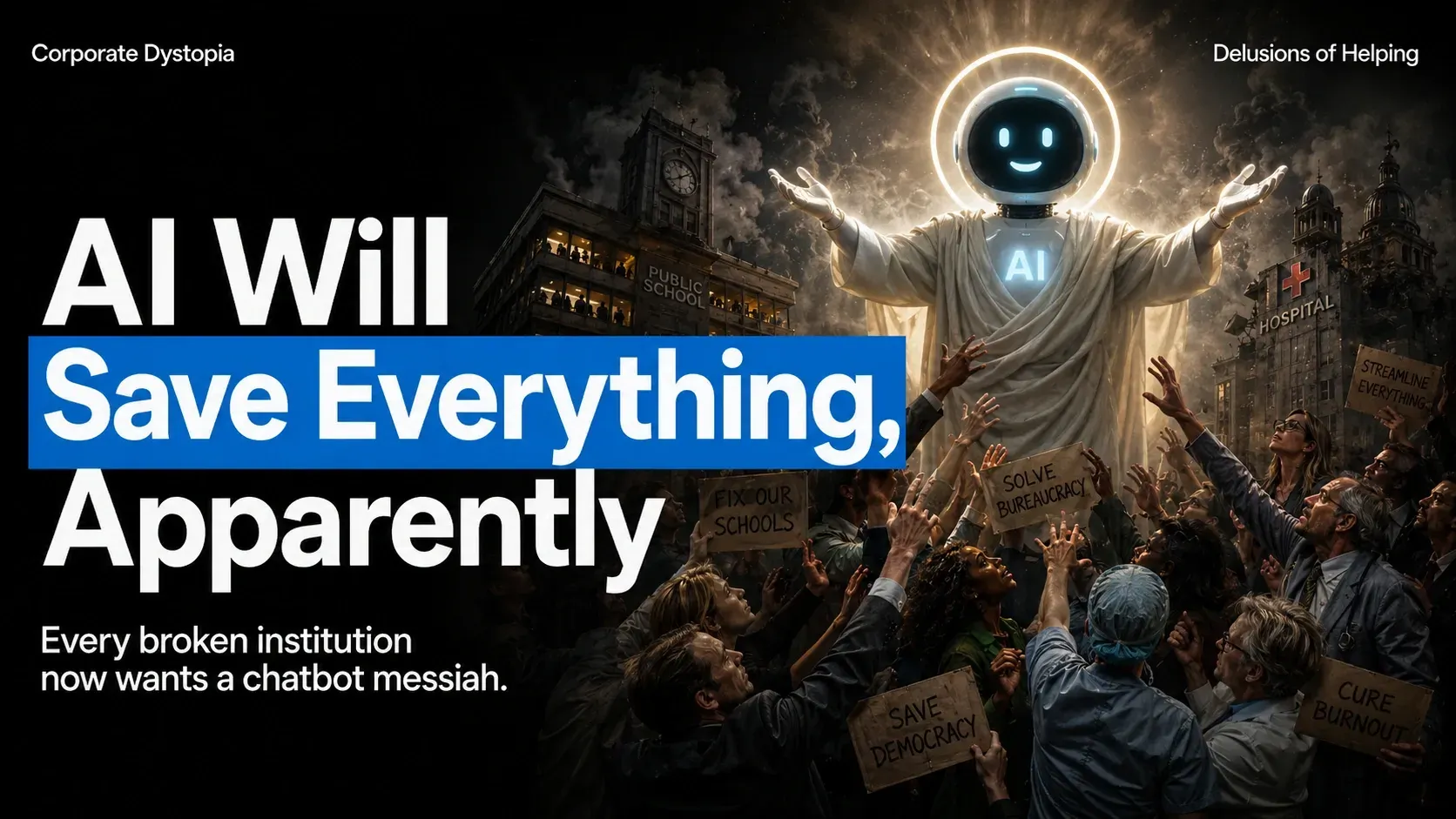
AI Will Save Everything, Apparently
Every era has a salvation technology. Right now, artificial intelligence is being asked to rescue almost everything.
By Chris Markl
AI will save everything, apparently.
It will save work. It will save education. It will save medicine. It will save government. It will save business. It will save creativity. It will save productivity. It will save lonely people. It will save overwhelmed workers. It will save customer service. It will save research. It will save coding. It will save public agencies. It will save students. It will save teachers. It will save democracy. It will save journalism. It will save climate planning. It will save the future.
Wonderful.
That is a lot of saving.
Maybe artificial intelligence will help many things. It already does. It can summarize, search, draft, classify, translate, analyze, brainstorm, automate, assist, detect patterns, speed up workflows, improve access, and make many kinds of work easier.
Technology can help.
The question is not whether AI is useful.
The question is whether every AI helping claim survives contact with reality.
Because the AI industry has learned the oldest trick in modern public life.
Do not merely sell a tool.
Sell rescue.
The product is not software. It is transformation.
The platform is not automation. It is empowerment.
The model is not prediction. It is intelligence.
The rollout is not a business strategy. It is the future arriving.
The company is not seeking market dominance. It is democratizing possibility.
This is Corporate Dystopia with better lighting.
A technology may be powerful and still be overhyped.
A product may be useful and still be sold with delusional language.
A company may create value and still obscure tradeoffs.
An AI system may improve one workflow while making another worse.
An automation may save time while degrading judgment.
A tool may increase output while flooding the world with mediocrity.
A model may answer quickly while being confidently wrong.
A platform may make work easier while making workers more replaceable.
A company may claim to empower people while concentrating power in itself.
That is why AI needs the same test as everything else claiming to help.
Did it help?
Did it help efficiently?
Did it help enough?
Did it help more than it harmed?
Could the same resources have helped more people another way?
Those questions sound boring compared to a product demo.
Good.
That is why they matter.
AI hype loves the demo because the demo compresses complexity into magic.
A prompt goes in.
A polished answer comes out.
The room reacts.
The future appears inevitable.
But reality is not the demo.
Reality is implementation.
Reality is training data, workflow design, error rates, user behavior, incentives, governance, privacy, energy use, labor impact, customer confusion, legal risk, public trust, and the quiet disaster of people using tools they do not understand to produce decisions they cannot explain.
AI can help a doctor.
It can also introduce false confidence.
AI can help a student.
It can also replace the struggle that builds judgment.
AI can help a public agency.
It can also automate bureaucracy faster.
AI can help a journalist.
It can also multiply content sludge.
AI can help a business.
It can also turn every customer interaction into a cheaper, emptier simulation of service.
The issue is not whether AI belongs in society.
It already does.
The issue is whether society can judge it without worshiping it.
A serious AI culture would stop asking only what the tool can do and start asking what the tool does to people, institutions, incentives, and attention.
Does it increase capability, or dependency?
Does it improve judgment, or bypass it?
Does it expand access, or create new gatekeepers?
Does it save workers time, or make their work less human?
Does it help students learn, or help them avoid learning?
Does it improve public services, or produce automated confusion?
Does it give communities opportunity, or turn them into infrastructure platforms for someone else’s intelligence business?
Everyone claims they are helping.
Fine.
Prove it.
The future does not need AI worship. It needs AI adulthood.
That means using powerful tools without surrendering judgment to them. It means demanding evidence from companies that sell transformation. It means asking who benefits, who pays, who governs, who is exposed, who is replaced, who is made more capable, and who becomes more dependent.
AI may be one of the most important technologies of our time.
That is exactly why the helping claims should be tested harder, not softer.
The more powerful the tool, the less we should tolerate magical language.
Artificial intelligence might help a lot.
Great.
Show the results.
Show the costs.
Show the tradeoffs.
Show the humans who are better off.
Until then, forgive us for not bowing before the chatbot altar.