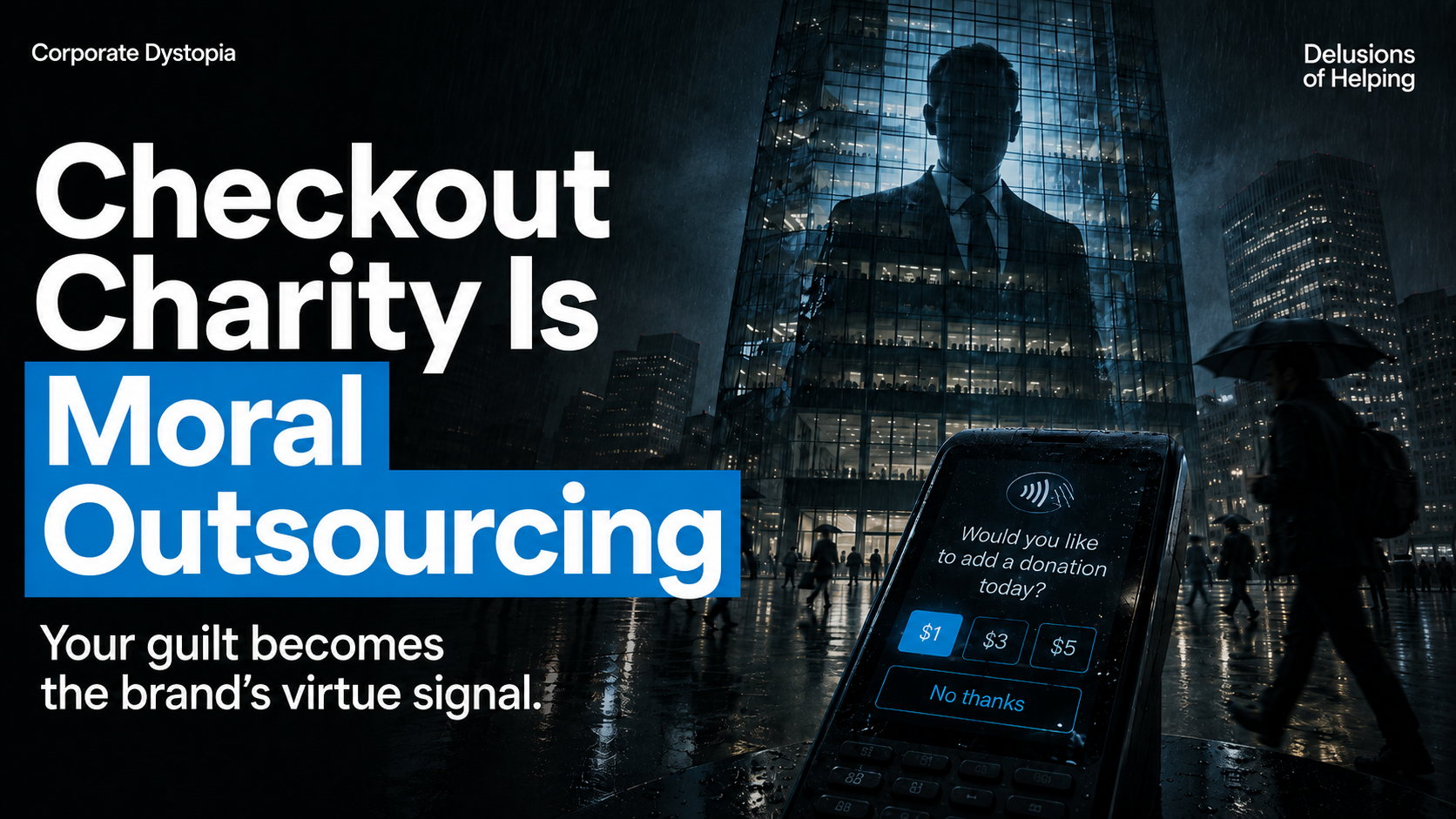
Checkout Charity Is Moral Outsourcing
The little donation prompt at the register turns your guilt into someone else’s virtue signal.
By Chris Markl
The screen appears.
Would you like to round up for children, hunger, veterans, disaster relief, literacy, cancer research, animal rescue, clean water, mental health, local families, global suffering, or some other cause that is impossible to oppose without feeling like a cartoon villain?
You wanted toothpaste.
Now you are in a moral referendum.
The cashier is watching. The line is waiting. The card reader is glowing with judgment. You have three options: donate one dollar, donate five dollars, or press the tiny button that basically says, “No thanks, I hate children.”
Welcome to checkout charity.
It is one of the most awkward little rituals in modern consumer life.
It is also a perfect example of Corporate Dystopia.
The company gets to host a generosity moment using your money, your attention, your guilt, and your social discomfort.
You pay.
The company gets moral atmosphere.
This does not mean the money is useless. Some checkout campaigns raise real funds for real causes. Some charities benefit. Some people may be helped. The dollar you donate may do something good.
Wonderful.
Then let us be honest about what is happening.
The corporation is not being generous when it asks customers to donate.
The customers are being generous.
The company is facilitating the ask.
That can still be valuable. Distribution matters. A large retailer can collect small donations at scale. A national brand can move money toward a cause faster than many charities could on their own. There is nothing automatically wrong with making giving convenient.
The delusion begins when the company absorbs the glow.
The brand looks compassionate. The store feels community minded. The campaign becomes part of the company’s social responsibility story. The customer gets a brief guilt transaction. The cause gets money. The corporation gets to stand near goodness.
Everyone claims they are helping.
Fine.
Prove it.
How much money was raised?
Where did it go?
How much reached the actual work?
Did the company match customer donations?
Did the company give its own money, or mostly collect yours?
Did the campaign improve anything measurable?
Did the charity become stronger, or did the brand simply get a cheap moral accessory?
Did the company create value beyond asking people at the register to feel bad for half a second?
These are not hostile questions.
They are basic adult questions.
Checkout charity is interesting because it compresses the entire moral economy into one tiny screen.
The company asks. The customer pays. The brand benefits.
The cause receives.
The public feels something.
The actual impact remains mostly invisible.
That structure should make people curious.
It should not make them automatically cynical. It should make them ask what the arrangement does and who gets credit.
Because corporate virtue often works this way.
A company finds a social cause close enough to its brand to feel meaningful, but not so costly that it threatens the business model. It creates a campaign. It invites customers to participate. It generates content, goodwill, and public association with the cause.
Sometimes the cause benefits.
Sometimes the brand benefits more.
The moral danger is not that people donate one dollar at checkout.
The moral danger is that society keeps confusing consumer participation with structural generosity.
You clicked the button.
You rounded up.
You bought the cause related product.
You wore the awareness bracelet.
You chose the brand that said it cares.
You experienced a small emotional cleansing through consumption.
But did anything change?
Maybe.
Fine.
Prove it.
A healthier version of checkout charity would be radically transparent.
The screen would say: “Customers donated this amount. The company matched this amount. This charity received this amount. This is what the money accomplished. This is how we know.”
That would be better.
It would also be less vibey.
The current version depends on vagueness. It works because nobody wants to interrogate a donation prompt while buying deodorant.
But Delusions of Helping exists for exactly that kind of moment.
The little moments reveal the big system.
Corporate virtue does not always arrive as a giant scandal. Sometimes it arrives as a tiny button asking whether you would like to be a good person today.
Maybe press yes.
Maybe press no.
But do not confuse the button with justice.
Do not confuse the transaction with transformation.
Do not confuse customer guilt with corporate generosity.
And definitely do not let a billion dollar company borrow your virtue without showing receipts.