The Beneficiary Photo Problem
The people being helped should not become props in the helper’s story.
By Chris Markl
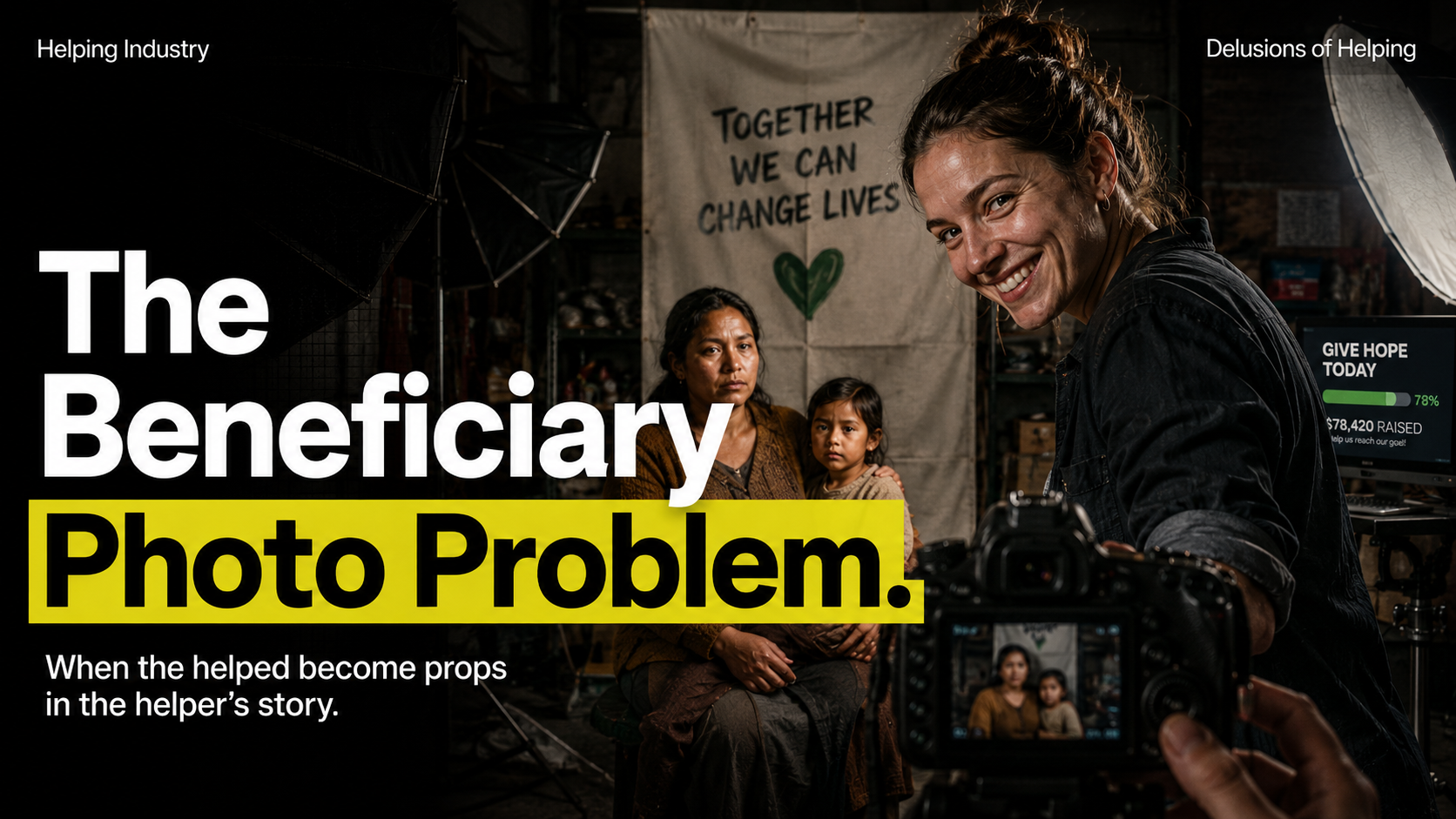
The photo is familiar.
A smiling child. A grateful family. A student holding a certificate. An entrepreneur standing beside a mentor. A volunteer handing someone food. A donor surrounded by beneficiaries. A group photo after a workshop. A public official shaking hands with someone whose hardship gives the moment moral weight.
The message is clear.
Look at the people we helped.
The image may be real. The emotion may be real. The organization may have done something useful. The person in the photo may genuinely feel grateful.
Still, the question remains.
Who is the photo for?
That is the beneficiary photo problem.
In the Helping Industry, the people being helped often become evidence for the helper.
Their faces prove the mission. Their stories move donors. Their vulnerability gives campaigns emotional force. Their gratitude reassures funders. Their presence turns an abstract program into a human story.
This can be done respectfully.
It can also become exploitation with soft lighting.
The difference is power.
Did the beneficiary gain power from the story, or did the helper gain power from the beneficiary?
That is the test.
The Helping Industry loves stories because stories work. A statistic can explain scale, but a face creates feeling. A report can describe hardship, but a quote creates intimacy. A chart can show need, but a photo tells the donor where to place their emotion.
There is nothing wrong with humanizing public problems.
The danger is turning people into moral props.
A beneficiary is not a mascot.
A poor person is not a fundraising asset.
A student is not a success decoration.
A struggling family is not a brand opportunity.
A disaster survivor is not content.
A community is not a backdrop for institutional virtue.
Everyone claims they are helping.
Fine.
Prove it.
Did the person in the photo have real consent?
Did they understand how the image would be used?
Could they say no without consequences?
Were they compensated?
Did they get to shape the story?
Were they portrayed with dignity, complexity, and agency?
Did the story show their strength, or only their need?
Did the campaign improve their life, or mainly improve the helper’s reputation?
These questions matter because the people with the least institutional power are often asked to carry the most emotional weight.
The funder has money.
The nonprofit has the platform.
The university has the logo.
The agency has the authority.
The donor has the praise.
The executive has the quote.
The beneficiary has the face.
That arrangement should make us careful.
A serious helping culture would not ban beneficiary stories. That would be absurd. People should be able to tell their stories. Organizations should be able to show real work. Donors should be able to understand who they are supporting. The public should see the human reality behind programs.
But the story should serve the helped, not merely the helper.
There is a difference between dignity and display.
Dignity says: this person is more than their hardship.
Display says: this person’s hardship makes our organization look good.
Dignity gives context.
Display gives emotion.
Dignity protects agency.
Display extracts gratitude.
Dignity asks what changed.
Display asks whether the donor felt something.
The beneficiary photo problem is not only about images. It is about the entire moral architecture of helping.
Who gets seen?
Who gets believed?
Who gets quoted?
Who gets paid?
Who gets praised?
Who gets to define success?
Who gets to say whether the help helped?
Too often, the helped are invited into the story after the strategy is already written, the grant is already awarded, the campaign is already designed, and the helper already knows what kind of emotional evidence is needed.
That is not beneficiary power.
That is beneficiary packaging.
A better standard would ask whether the helped gained safety, capability, income, health, freedom, stability, knowledge, dignity, or influence because the organization existed.
If the answer is yes, great.
Tell the story carefully.
If the answer is unclear, do not hide behind a smiling photo.
A smile can be gratitude.
It can also be politeness.
It can also be discomfort.
It can also be survival.
It can also be what someone does when a powerful institution points a camera at them and says this will help the program.
The photo does not prove impact.
The story does not prove empowerment.
The quote does not prove transformation.
The helper still has to answer the harder question.
Did the helped become better off, or did they become better evidence?
That is the beneficiary photo problem.
And any organization serious about helping should be brave enough to ask it before publishing the picture.