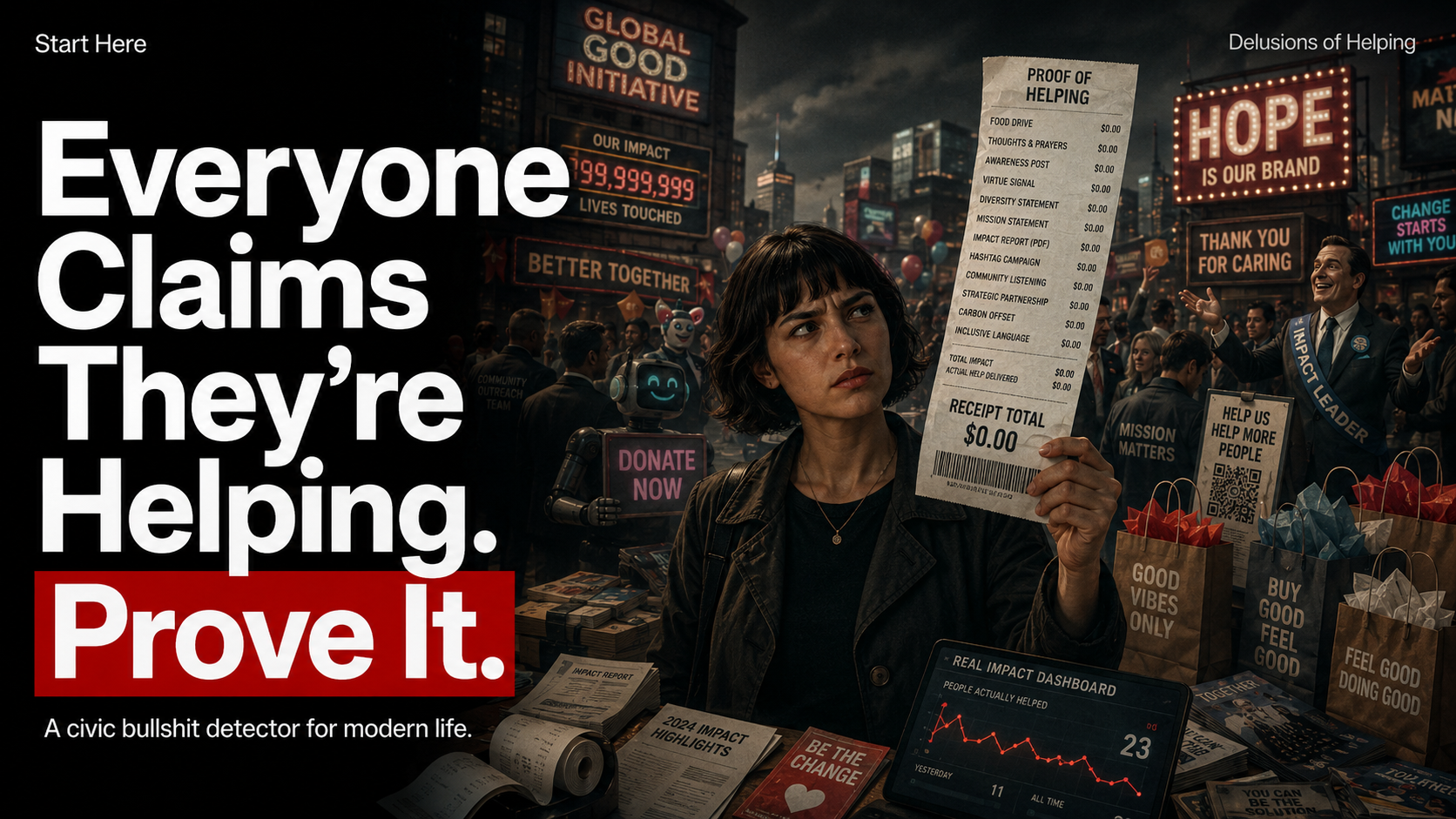
Everyone Claims They’re Helping. Fine. Prove It.
A manifesto against fake impact and the beginning of a news platform built to test politics, media, business, culture, education, technology, and everything claiming to help.
By Chris Markl
Everyone claims they are helping.
Politicians claim they are saving democracy. Government agencies claim they are serving the public. Nonprofits claim they are changing lives. Corporations claim they are building a better world. Media companies claim they are informing citizens. Universities claim they are producing knowledge. Technology companies claim they are connecting humanity, democratizing intelligence, and improving the future.
Activists claim they are fighting for justice. Influencers claim they are raising awareness. Celebrities claim they are using their platforms. Consultants claim they are creating impact. Foundations claim they are solving systemic problems. Brands claim every purchase is a moral statement. Campaigns claim every election is the most important election of our lifetime.
Fine.
Prove it.
That is the entire idea behind Delusions of Helping.
The book began with a simple frustration: almost every powerful person, institution, industry, movement, party, brand, agency, and platform has learned to speak the language of helping. Everyone has a mission. Everyone has values. Everyone has a theory of change. Everyone has a campaign, initiative, framework, task force, fund, report, summit, dashboard, or awareness month.
But the question that matters is often the one nobody wants to answer directly:
Did it help?
Not did it sound compassionate.
Not did it make the helper look good.
Not did it produce a press release.
Not did it generate engagement.
Not did it feel righteous.
Not did it satisfy the donors, voters, funders, customers, administrators, audiences, or algorithms.
Did it help?
And if it did, how much? At what cost? For whom? Compared to what? Could the same time, money, attention, authority, outrage, bureaucracy, or goodwill have helped more people another way?
That is where modern life gets uncomfortable.
Because a lot of what we call helping is not really helping. It is performance. It is identity. It is marketing. It is politics. It is bureaucracy. It is moral theater. It is emotional self-medication. It is institutional self-preservation. It is content. It is status. It is rescue fantasy. It is a way to feel good, look good, sound good, or gain power without being forced to prove that anyone’s life actually got better.
That is the delusion.
And it is everywhere.
The Book Is the Foundation. This Site Is the Machine.
Delusions of Helping started as a book, but the argument was never meant to stay trapped between covers.
The book is the foundation. This site is the machine that applies it to reality.
The news tells you what happened. Delusions of Helping asks whether any of it actually helped.
Every day, the world produces new helping claims. A politician announces a historic plan. A company launches a values campaign. A university celebrates a new initiative. A nonprofit releases an impact report. A celebrity posts a moral lecture. A government agency expands a program. A media outlet turns a complicated story into emotional fuel. A technology company promises to revolutionize humanity again.
The normal news cycle asks: Who said it? Who is angry? What does the other side think? How will it affect the election? Is this good for the brand? Who posted about it? Can we get a clip?
This site asks different questions.
What is being claimed?
Who benefits from the claim?
Who is supposed to be helped?
Did the helped gain power, safety, capability, freedom, dignity, opportunity, or stability?
What did it cost?
What was measured?
What was ignored?
What would have helped more?
Was this help, or was this a delusion of helping?
That is the editorial standard.
Not left. Not right. Not centrist mush. Not cheap outrage pretending to be analysis. Not institutional politeness pretending to be seriousness.
A civic bullshit detector for modern life.
Helping Has Become an Industry
The problem is not that people stopped caring. In some ways, the opposite is true. We live in a culture drowning in claimed concern.
There are more missions, more causes, more campaigns, more foundations, more initiatives, more public statements, more values pages, more awareness posts, more trainings, more toolkits, more committees, more philanthropic strategies, more impact dashboards, more moral branding, and more urgent declarations than almost anyone can process.
And yet somehow, many people feel poorer, angrier, lonelier, less informed, less capable, less trusting, less stable, and less hopeful.
That does not mean all helping is fake. Real helping exists. Real public servants exist. Real teachers exist. Real nonprofits exist. Real businesses create value. Real policies improve lives. Real journalism informs citizens. Real technology can expand opportunity. Real education can build judgment. Real culture can deepen meaning.
The point is not to sneer at helping.
The point is to defend helping from the people and institutions that use its language without accepting its discipline.
Because helping should be judged by reality, not intention.
That means good intentions are not enough. Compassion is not enough. Awareness is not enough. Funding is not enough. Activity is not enough. Credentials are not enough. Public emotion is not enough. A beautiful mission statement is not enough. A viral post is not enough. A press release is not enough. A new office, new program, new title, new campaign, or new slogan is not enough.
The question remains:
Did it help?
What We Cover
This publication exists to investigate the delusions hiding underneath modern public life.
The categories are not neutral newspaper buckets. They are diagnoses.
Savior Politics
Politics keeps selling rescue.
Every election is existential. Every candidate is a savior or a demon. Every executive order is historic. Every party claims it alone can protect democracy, freedom, justice, workers, families, markets, schools, children, borders, rights, safety, or the future.
Government matters. Policy matters. Elections matter.
But politics becomes delusional when it sells salvation it cannot deliver.
Savior Politics is where we test campaigns, leaders, government promises, bureaucracy, public spending, executive orders, policy theater, and the fantasy that power will save us.
Helping Industry
Helping is now a profession, a brand identity, a funding model, a career path, a marketing strategy, and an institutional ecosystem.
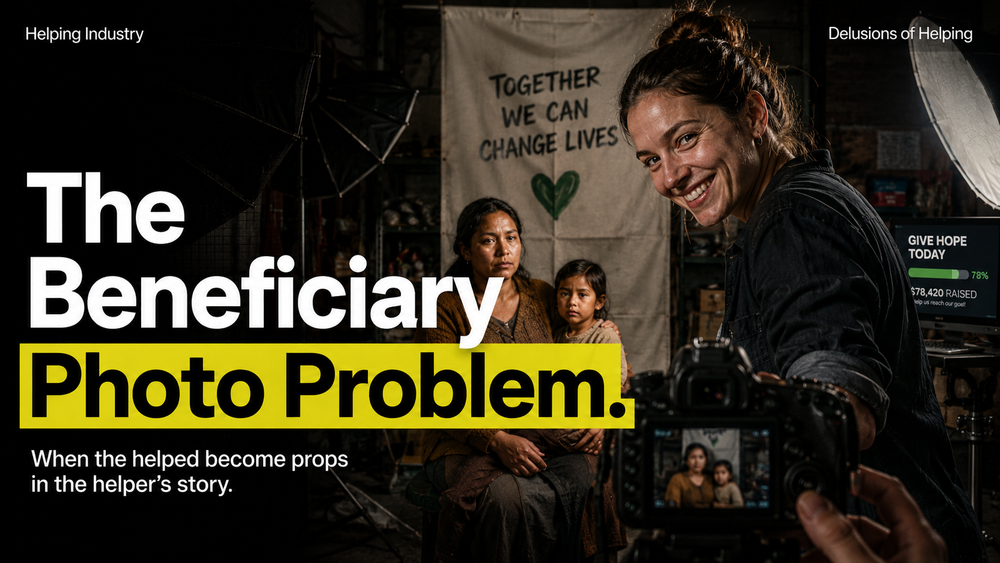
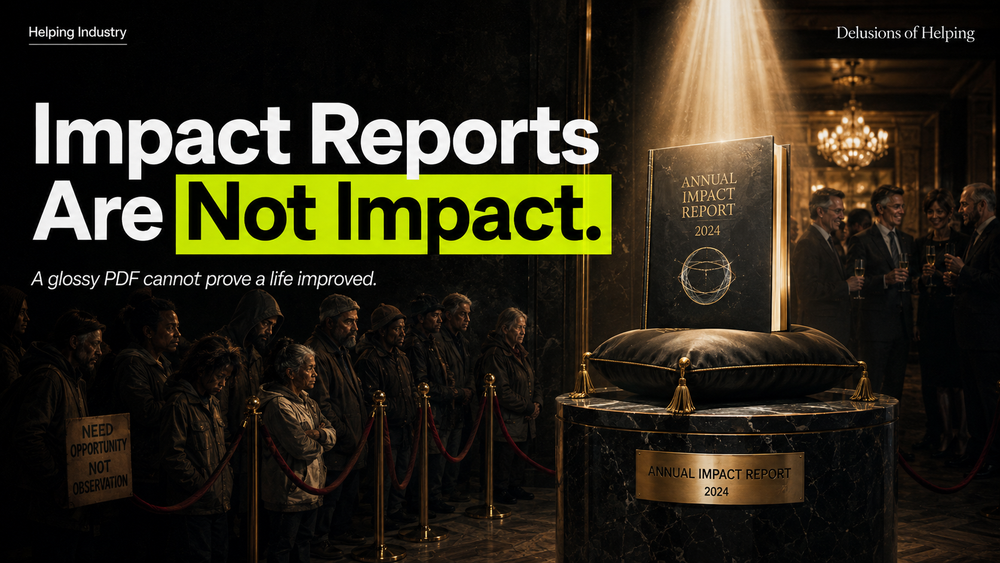
Nonprofits, foundations, universities, consultants, government-adjacent organizations, NGOs, philanthropists, and social-impact professionals all claim to improve lives. Some do. Some mostly produce reports, meetings, grants, photos, dashboards, convenings, and beautiful language.
Helping Industry is where we test fake impact, grant theater, nonprofit performance, philanthropic branding, beneficiary storytelling, outcome measurement, and professionalized do-gooding.
Outrage Machine
Outrage is one of the easiest feelings to monetize.
Media companies, social platforms, influencers, activists, politicians, and commentators all know how to farm your nervous system. They know which headline will make you click, which clip will make you furious, which framing will make you feel morally superior, and which enemy will keep you coming back.
Some outrage is justified. Some anger is necessary. Some public pressure matters.
But outrage becomes delusional when it replaces impact.
Outrage Machine is where we test news hysteria, social media panics, protest theater, clickbait, moral performance, grievance farming, and the gap between caring loudly and helping effectively.
Corporate Dystopia
Corporations no longer just sell products. They sell identity, morality, belonging, values, convenience, intelligence, empowerment, sustainability, connection, and the future.
Brands claim to be movements. Platforms claim to build community. Technology companies claim to save humanity. AI companies claim to democratize intelligence. Data centers claim to power progress. Retailers ask you to donate at checkout. Corporate values appear and disappear depending on incentives.
Some companies create real value. Some technologies improve life. Some infrastructure is necessary.
But corporate power becomes delusional when it disguises extraction as progress, surveillance as convenience, manipulation as personalization, greenwashing as responsibility, and profit strategy as moral leadership.
Corporate Dystopia is where we test brands, technology, AI, platforms, data centers, algorithms, surveillance, ESG, DEI, greenwashing, consumer manipulation, corporate virtue, and corporate power.
Culture Rot
A healthy culture helps people become more capable, grounded, honest, connected, peaceful, responsible, and alive.
A rotting culture trains people to consume drama, worship fame, confuse attention with meaning, turn every purchase into identity, mistake entertainment for purpose, and outsource judgment to celebrities, influencers, teams, brands, and trends.
Culture Rot is where we test celebrity wisdom, sports worship, luxury morality, consumer salvation, dating and family dysfunction, entertainment addiction, lifestyle performance, and all the strange little ways modern culture teaches people to avoid reality.
Sometimes a taco can just be a taco.
Knowledge Grift
Modern society produces more information than wisdom.
We have degrees without judgment, studies without understanding, experts without humility, gurus selling certainty, influencers selling insight, AI generating slop, institutions laundering nonsense, and people confusing credentials with capability.
Education should make people harder to exploit, manipulate, impoverish, radicalize, addict, destabilize, and destroy.
Knowledge Grift is where we test education, credentials, fake expertise, gurus, disinformation, AI slop, pseudo-research, therapy-speak, bad data, fake critical thinking, and the knowledge systems that claim to produce wisdom but often produce confusion.
The Standard
This site will be built around a simple test.
When someone claims to help, we ask:
Did it help?
Did it help efficiently?
Did it help enough?
Did it help more than it harmed?
Could the same resources have helped more people another way?
That is not cynicism. That is respect.
It respects the public enough not to manipulate them. It respects beneficiaries enough not to turn them into props. It respects taxpayers enough not to waste their money. It respects donors enough not to sell them fake impact. It respects students enough not to bury them in debt for credentials without capability. It respects citizens enough not to farm their outrage for clicks. It respects customers enough not to sell them moral identity disguised as consumption.
Most importantly, it respects helping enough to take it seriously.
Because fake helping is not harmless.
Bad helping does not merely fail. Bad helping prevents better helping.
Every dollar wasted on performance is a dollar not spent on reality. Every hour spent in pointless meetings is an hour not spent solving the problem. Every media panic that hijacks public attention pulls energy away from things that matter. Every institution that protects itself from measurement makes improvement harder. Every moral performance that rewards the helper while ignoring the helped makes the world a little more dishonest.
The damage is not just inefficiency.
The damage is opportunity cost, public exhaustion, institutional distrust, cultural stupidity, emotional manipulation, and the slow death of the belief that anything can actually get better.
This Is Not a Project Against Helping
This part matters.
Delusions of Helping is not an argument against helping.
It is an argument against delusion.
The goal is not to become detached, smug, cruel, or cynical. Cynicism is easy. Cynicism lets people feel intelligent without becoming useful. Cynicism sees failure and calls that wisdom.
That is not the point.
The point is to become honest enough to help.
That requires discipline. It requires measurement. It requires humility. It requires asking whether our preferred solutions worked. It requires admitting when they did not. It requires caring more about the helped than the helper. It requires resisting the emotional pleasure of outrage when outrage does not improve reality. It requires questioning our favorite side, not just the other one.
It requires a culture that can say:
This sounded good, but did not work.
This helped, but not enough.
This helped some people while hurting others.
This cost too much for what it achieved.
This was well-intentioned, but poorly designed.
This made us feel righteous, but changed nothing.
This was not helping. This was theater.
And then it requires the harder question:
What would actually help?
Why This Exists Now
Modern life is full of people and institutions asking for your trust.
Trust this campaign.
Trust this expert.
Trust this platform.
Trust this headline.
Trust this brand.
Trust this agency.
Trust this foundation.
Trust this university.
Trust this movement.
Trust this technology.
Trust this leader.
Trust this side.
No.
Earn it.
If you claim to help, show the evidence. If you claim to serve, show the results. If you claim to inform, stop farming outrage. If you claim to educate, produce judgment. If you claim to empower, show who gained power. If you claim to innovate, show who benefits and who pays. If you claim to care, accept measurement.
The age of automatic moral credit should end.
That is why this site exists.
To test the helping claims underneath the news.
To expose fake impact.
To laugh at the absurdity without surrendering to despair.
To build a sharper public standard.
To ask better questions.
To stop being idiots about what actually helps.
Welcome to Delusions of Helping
This is a book.
This is a publication.
This is a reality test.
This is a civic bullshit detector for modern life: politics, government, nonprofits, news, social media, education, technology, culture, consumerism, and everything claiming to help.
Some days, it will be funny. Some days, it will be angry. Some days, it will be analytical. Some days, it will be uncomfortable. The goal is not to perform balance. The goal is to tell the truth as clearly as possible.
Everyone claims they are helping.
Fine.
Prove it.