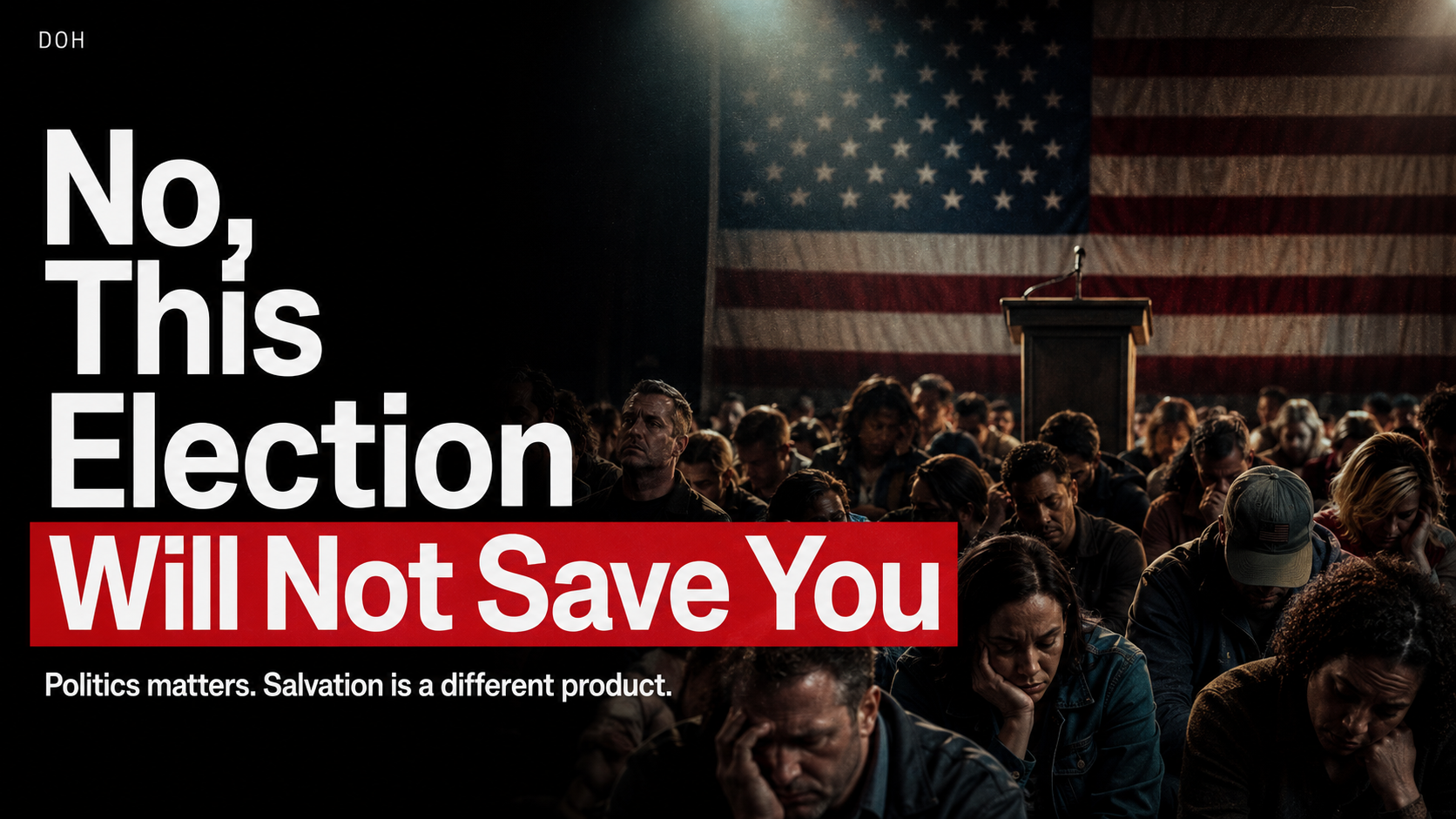
No, This Election Will Not Save You
Elections matter. But every election sold as salvation is already a warning sign.
By Chris Markl
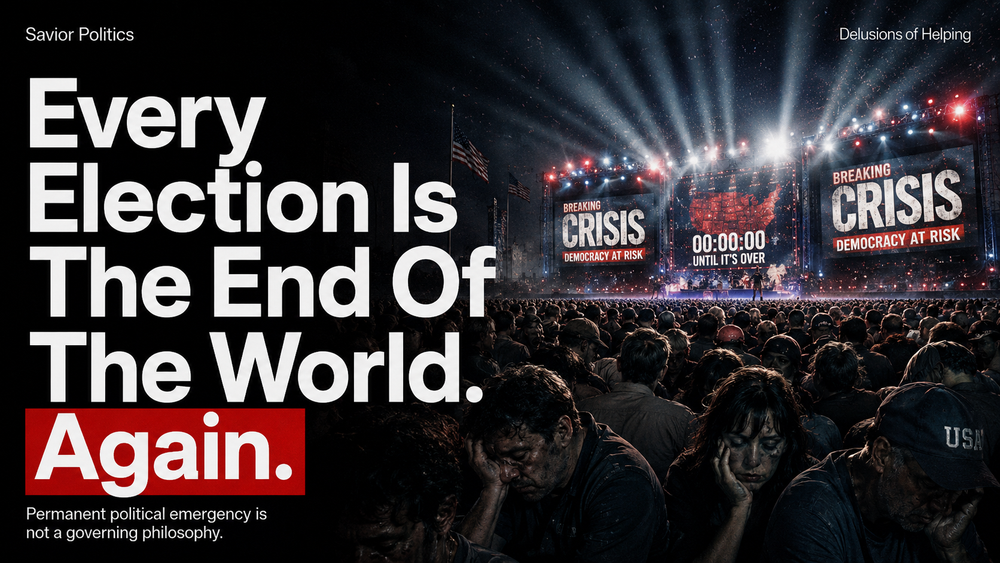
Every election is apparently the most important election of our lifetime.
Again.
Every cycle, we are told that democracy, freedom, justice, civilization, decency, markets, borders, children, families, workers, rights, truth, and the future itself are on the ballot.
Elections are mechanisms for power, not salvation rituals.
Every candidate becomes either a savior or a threat to existence. Every party becomes the last defense against catastrophe. Every campaign ad becomes a miniature apocalypse. Every donor email sounds like it was written by someone trapped inside a burning courthouse.
Vote now or everything ends.
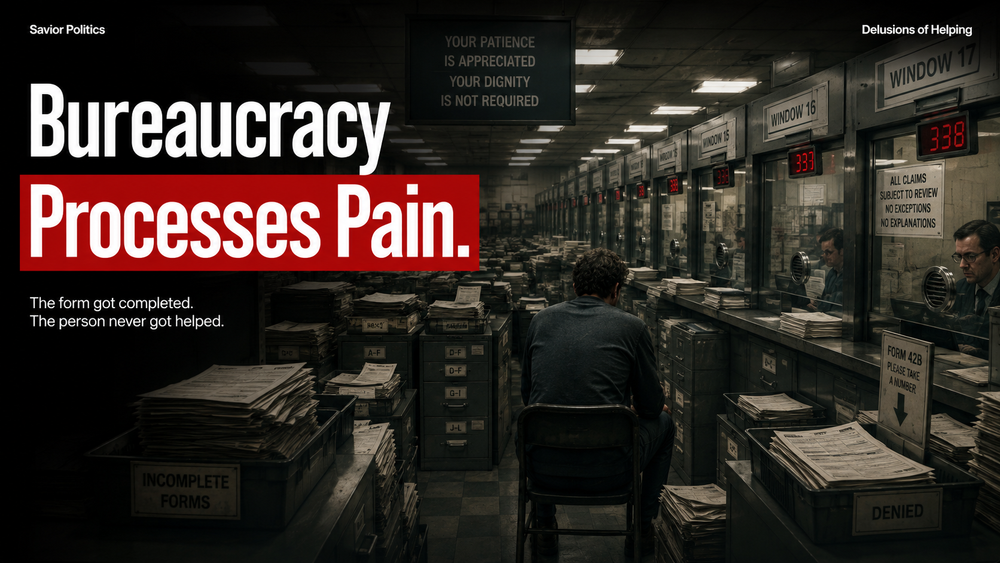
Then the election ends. The country remains complicated. The problems remain expensive. The institutions remain slow. The incentives remain broken. The bureaucracy remains alive. The debt remains real. The media moves to the next emergency. The consultants invoice. The donors are thanked. The voters are told to stay engaged because the next election may be even more important.
This is savior politics.
It does not mean elections are meaningless. Elections matter. Leadership matters. Law matters. Courts matter. Agencies matter. Budgets matter. Personnel matters. Policy matters. Power matters.
But elections are not salvation rituals.
They are mechanisms for allocating public authority inside a flawed system filled with tradeoffs, incentives, constraints, incompetence, ambition, vanity, fear, money, bureaucracy, and human beings.
That is less emotionally satisfying than believing the right candidate can redeem the nation.
It is also closer to reality.
The delusion of savior politics is not that politics matters too much. It is that politics promises more rescue than it can deliver.
A candidate cannot make your life meaningful. A party cannot repair your family. A president cannot give you inner peace. A governor cannot make the culture sane. Congress cannot legislate spiritual maturity. A campaign cannot substitute for civic competence. A slogan cannot rebuild trust. A speech cannot fix administrative failure. A viral clip cannot create institutional performance.
And yet politics keeps selling rescue because rescue sells.
Fear raises money. Doom increases turnout. Outrage drives attention. Enemies simplify complexity. Salvation gives politics emotional power that ordinary governance cannot match.
“Here is a complicated policy tradeoff” is not as effective as “they are destroying America.”
“Here is a partial improvement with implementation challenges” does not produce the same energy as “we will save democracy.”
“Here are measurable goals, costs, and accountability structures” does not fit on a yard sign.
So politics becomes theater. The stakes are inflated. The enemy is dehumanized. The base is emotionally farmed. The press covers the fight. The platforms amplify the rage. The public gets exhausted. The underlying systems remain under measured and under repaired.
Everyone claims they are helping.
Fine.
Prove it.
If a campaign says it will help workers, show the mechanism.
If a party says it will protect democracy, show the institutional reforms.
If a candidate says they will restore safety, show the operational plan.
If an administration says it will help families, show how costs, wages, housing, schools, health care, and public services actually change.
If a movement says it is saving the country, show who gained power, security, capability, opportunity, and freedom.
The standard is not whether the speech sounded moral.
The standard is not whether your side cheered.
The standard is not whether the other side got angry.
The standard is whether anything improved in reality.
Savior politics wants citizens to confuse participation with rescue. It wants us to believe voting is the beginning, middle, and end of civic duty. It wants us to experience politics as identity, drama, belonging, and emotional release.
A healthier politics would ask harder questions.
Did this policy help?
Did it help efficiently?
Did it help enough?
Did it help more than it harmed?
Could the same resources have helped more people another way?
Those questions are not as entertaining as campaign panic. They are not as addictive as outrage. They will not make a candidate look like a messiah.
Good.
That is the point.
Politics should be judged by performance, not salvation fantasy.
The country does not need another election described as the final battle for everything good. It needs adults capable of measuring whether power produced public value.
Vote. Care. Pay attention. Organize. Argue. Demand better.
But do not hand your soul to a campaign.
No election will save you.
The work continues after the votes are counted.