Bureaucracy Is Where Good Intentions Go to Be Processed Forever
Government often begins with a promise to help. Then the promise enters the machinery.
By Chris Markl
Bureaucracy is where good intentions go to be processed forever.
A public problem appears. People are suffering. A community needs help. A program is created. A law is passed. A benefit is announced. A department is assigned. A form is designed. A portal is launched. A committee is formed. A policy is written. A process is established.
The public does not live inside the org chart. People live inside problems.
The promise is simple.
Help is coming.
Then the promise enters the machinery.
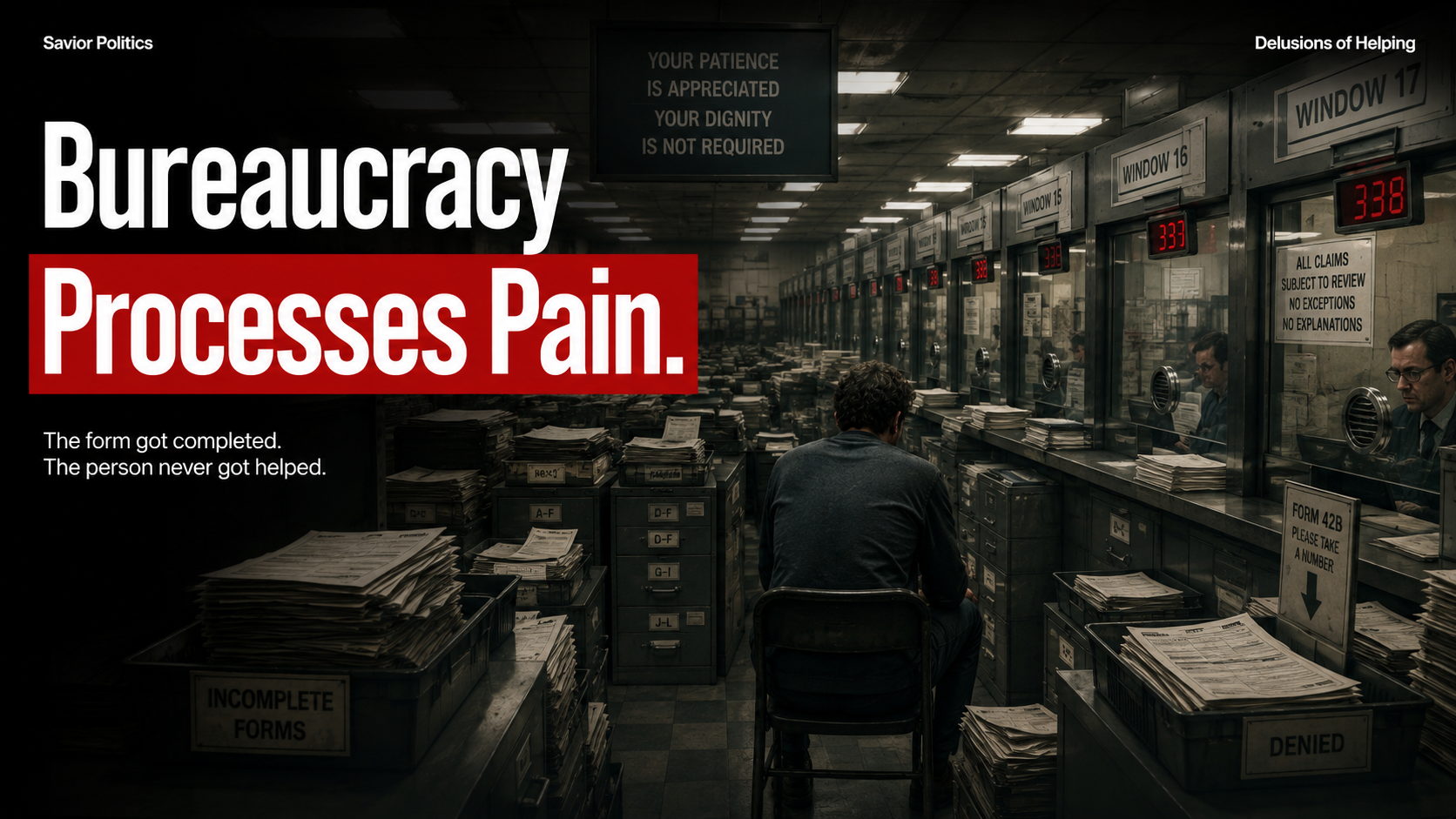
The person who needs help has to find the right office. The office has a website. The website has a PDF. The PDF has eligibility rules. The rules require documentation. The documentation requires an account. The account requires verification. Verification fails because the system does not recognize the address. The phone number leads to a menu. The menu says call volume is unusually high, which is strange because call volume appears to have been unusually high since the invention of the telephone.
Eventually, the person gets a form.
The form is not evil.
That is the worst part.
The form was created for reasons. Fraud prevention. Compliance. Consistency. Reporting. Legal risk. Budget control. Eligibility. Data collection. Audit requirements. Program design. Someone can explain every field.
Individually, each requirement may sound reasonable.
Together, they become a wall.
This is how government helping often fails. Not through one dramatic act of cruelty. Through accumulated friction.
Every step adds a little burden.
Every office adds a little delay.
Every rule adds a little confusion.
Every approval adds a little waiting.
Every system adds a little password reset.
By the time help arrives, the person may be exhausted, humiliated, late, rejected, confused, or gone.
The agency can still say the program exists.
The public can still say help was provided.
The politician can still say the benefit was funded.
The dashboard can still count applications, calls, approvals, and services delivered.
But the human experience may be miserable.
Everyone claims they are helping.
Fine.
Prove it.
Did the help reach people in time?
Was it easy to access?
Was it understandable?
Was it respectful?
Was it designed around the person in need, or around the institution protecting itself?
Did the process reduce suffering, or did it add a paperwork tax to suffering?
That phrase matters.
Paperwork tax.
It is the hidden cost government often imposes on people with the least time, money, stability, literacy, language access, health, transportation, childcare, confidence, or institutional trust.
The middle class person calls it annoying.
The vulnerable person experiences it as exclusion.
A complicated form is not neutral.
A confusing website is not neutral.
A long wait time is not neutral.
A missing translation is not neutral.
A process that requires three offices, four documents, two passwords, and a printer is not neutral.
It decides who gets help.
Bureaucracy becomes delusional when it measures whether the system completed its process instead of whether the person was helped.
The agency says the application was reviewed.
The citizen says they never understood what was missing.
The agency says the notice was sent.
The citizen says the letter was incomprehensible.
The agency says the call center is available.
The citizen says nobody answered.
The agency says the benefit exists.
The citizen says they could not survive the process.
Both stories may be true.
Only one reveals whether helping happened.
This does not mean bureaucracy is pointless. Complex societies need administration. Public money needs rules. Programs need eligibility. Agencies need records. Fraud prevention matters. Fairness matters. Legal compliance matters. Consistency matters. Government cannot run on vibes.
But bureaucracy should be a tool for delivering public value.
Too often, it becomes the thing being protected.
The process becomes sacred.
The rule becomes more important than the reason for the rule.
The meeting becomes the output.
The report becomes the proof.
The system becomes excellent at explaining why it cannot do the thing it was created to do.
This is why bureaucracies are so hard to fix. Every burden has a defender. Every delay has a rationale. Every pointless step has a history. Every confusing policy exists because at some point someone needed control, protection, documentation, or plausible deniability.
Then the institution forgets to ask whether the accumulated result still helps.
A serious government would ask different questions.
How many steps does it take to receive help?
How long does each step take?
Where do people drop off?
Which requirements exclude people unnecessarily?
What language confuses applicants?
What documents are hardest to obtain?
Which office owns the outcome?
Who is responsible for reducing burden?
What would the process feel like to someone under stress?
That last question should be mandatory.
Design the system for the person who is tired, scared, busy, poor, sick, grieving, working two jobs, caring for children, lacking transportation, reading in a second language, or trying not to fall apart.
Then see how much of the process still seems reasonable.
Bureaucracy is not only a government problem. Nonprofits do it. Universities do it. Hospitals do it. Foundations do it. Corporations do it. Any institution can become better at managing people through a system than helping them through a problem.
But government has a special obligation because it uses public authority and public money.
If the state claims to help, it must care about access, burden, speed, clarity, dignity, and results.
Not just compliance.
The public does not live inside the org chart.
People live inside problems.
A helping system should meet them there.