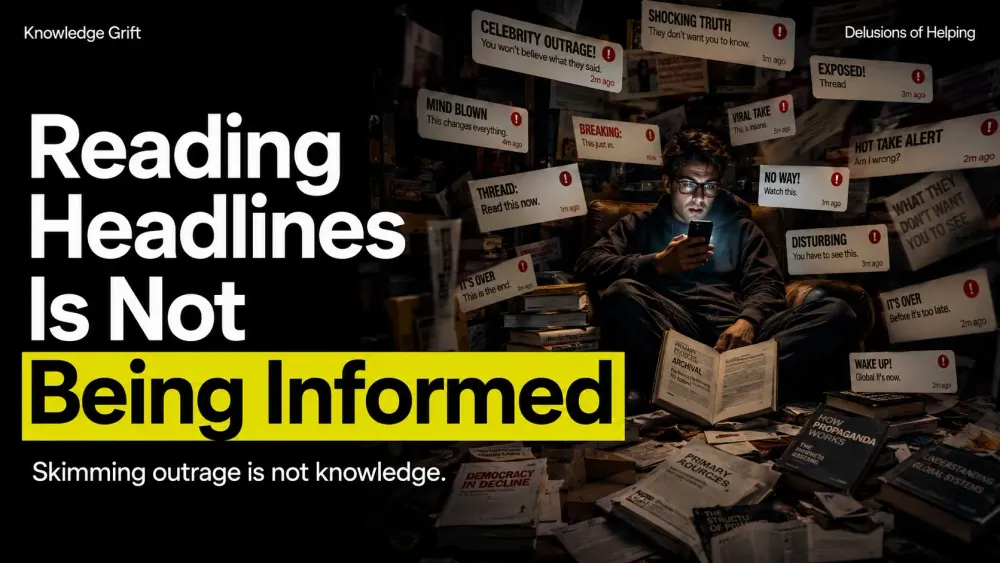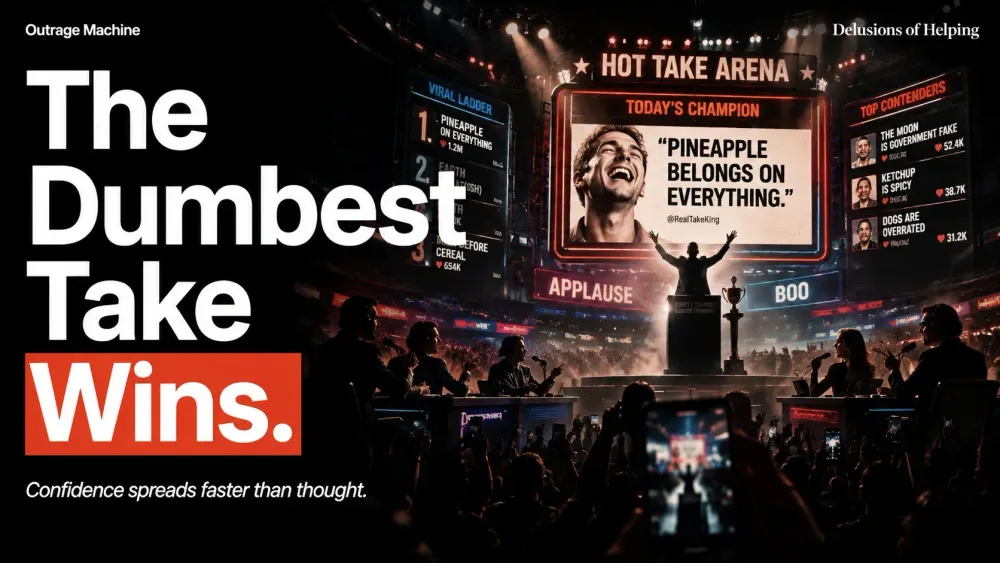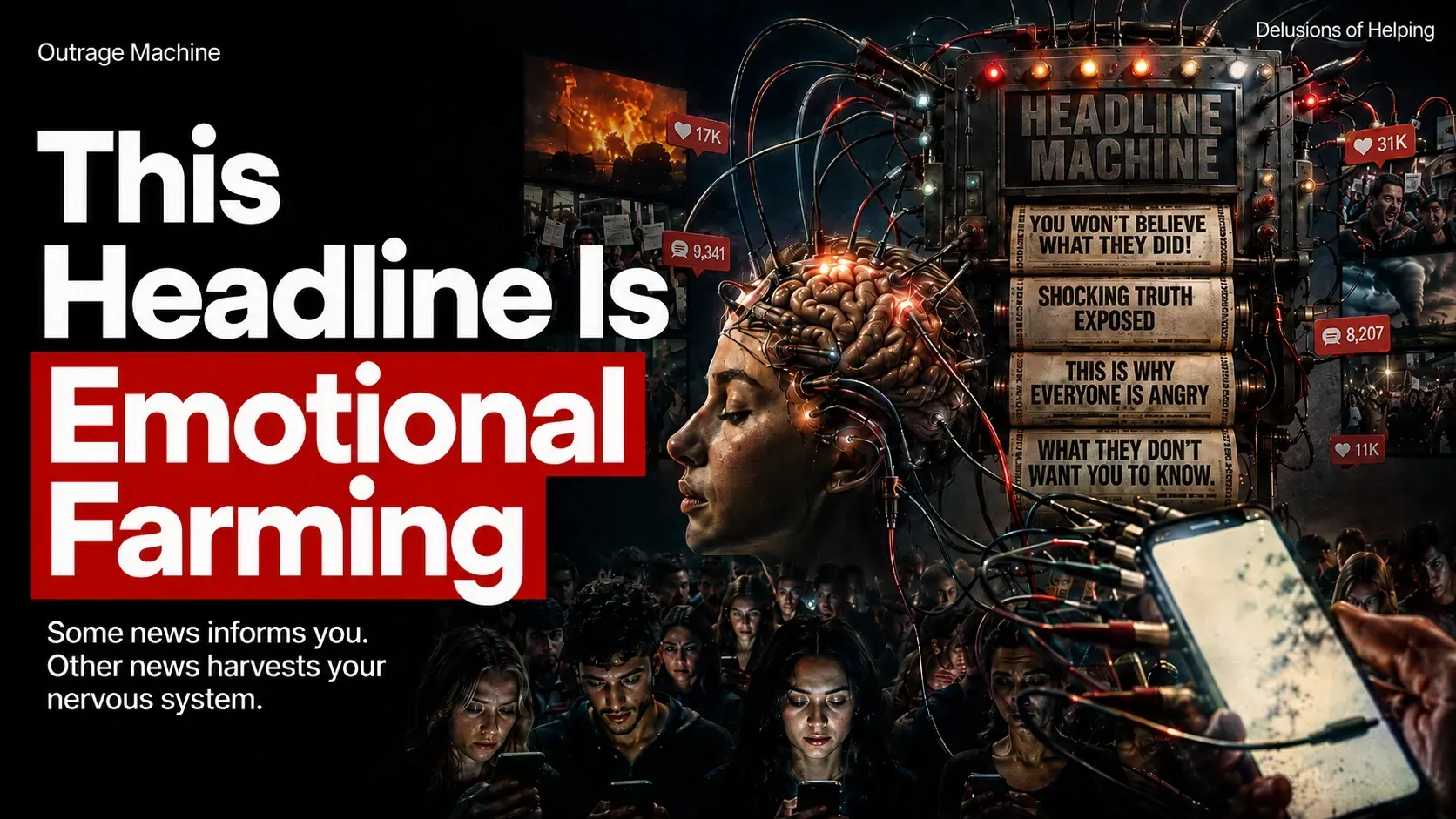
This Headline Is Emotional Farming
Some headlines inform you. Others harvest your nervous system.
By Chris Markl
Some headlines are written to inform you.
Many are written to activate you.
You know the difference because your body knows before your mind does.
The headline appears. Your chest tightens. Your anger wakes up. Your tribe assembles in your imagination. The villain is obvious. The moral meaning is preloaded. The story has already told you how to feel before it has earned the right to tell you what happened.
That is emotional farming.
The product is not information. The product is your nervous system.
Modern media does not merely report events. It competes for attention inside a crowded market of panic, identity, resentment, fear, status, and entertainment. Every story has to fight every other story, every social platform, every video, every text message, every sports clip, every celebrity scandal, every group chat, every political meltdown, and every algorithmic suggestion designed to keep you from leaving.
So the headline becomes bait.
Not always fake. Not always wrong. Often worse.
Emotionally optimized.
It selects the most inflammatory angle. It removes the dull context. It sharpens the villain. It compresses ambiguity. It rewards the reader for already believing the expected thing. It turns public life into a permanent moral emergency.
This is not an accident.
Anger travels. Fear travels. Disgust travels. Humiliation travels. Tribal certainty travels. “You will not believe what they did” travels much faster than “a complex situation produced mixed evidence and several plausible interpretations.”
The Outrage Machine understands this.
It knows that people want to feel informed, but often click because they want to feel right.
It knows that people say they hate negativity, but respond to threat.
It knows that a story framed as “here is what happened” has less viral power than a story framed as “your enemies are worse than you thought.”
This does not mean every controversy is fake. Some outrage is justified. Some abuse should be exposed. Some corruption should produce anger. Some injustice deserves public pressure. A numb society is not a healthy society.
But outrage becomes delusional when it replaces judgment.
The question is not “can this story make me angry?”
Almost anything can make someone angry if framed correctly.
The better question is:
What actually happened?
What is being left out?
Who benefits from my reaction?
What would change if everyone got mad?
Is there a real path from attention to improvement?
Does this help anyone, or does it just keep me emotionally available to the machine?
That last question matters.
Because the Outrage Machine does not need you to solve anything. It needs you to return.
It needs you anxious enough to check again. Angry enough to share. Righteous enough to comment. Suspicious enough to distrust anyone who complicates the story. Exhausted enough to confuse emotional participation with civic duty.
This is how awareness becomes a trap.
You can spend all day consuming stories about problems and never become more useful to solving them. You can be constantly informed and poorly oriented. You can know every controversy and understand very little. You can care loudly and help no one.
That is the Outrage Impact Gap.
The gap between how much emotion a story generates and how much improvement it produces.
A healthy news system would narrow that gap. It would help people understand reality, judge claims, locate responsibility, assess tradeoffs, and act intelligently.
A broken news system widens the gap. It gives people endless emotional stimulation with almost no practical power.
The headline says something outrageous happened.
Maybe it did.
But before donating your nervous system, ask for the receipt.
What happened?
Who knows?
What is proven?
What is framed?
What is missing?
What would actually help?
Until then, be careful.
Some headlines are not news.
Some headlines are little machines built to farm your feelings.