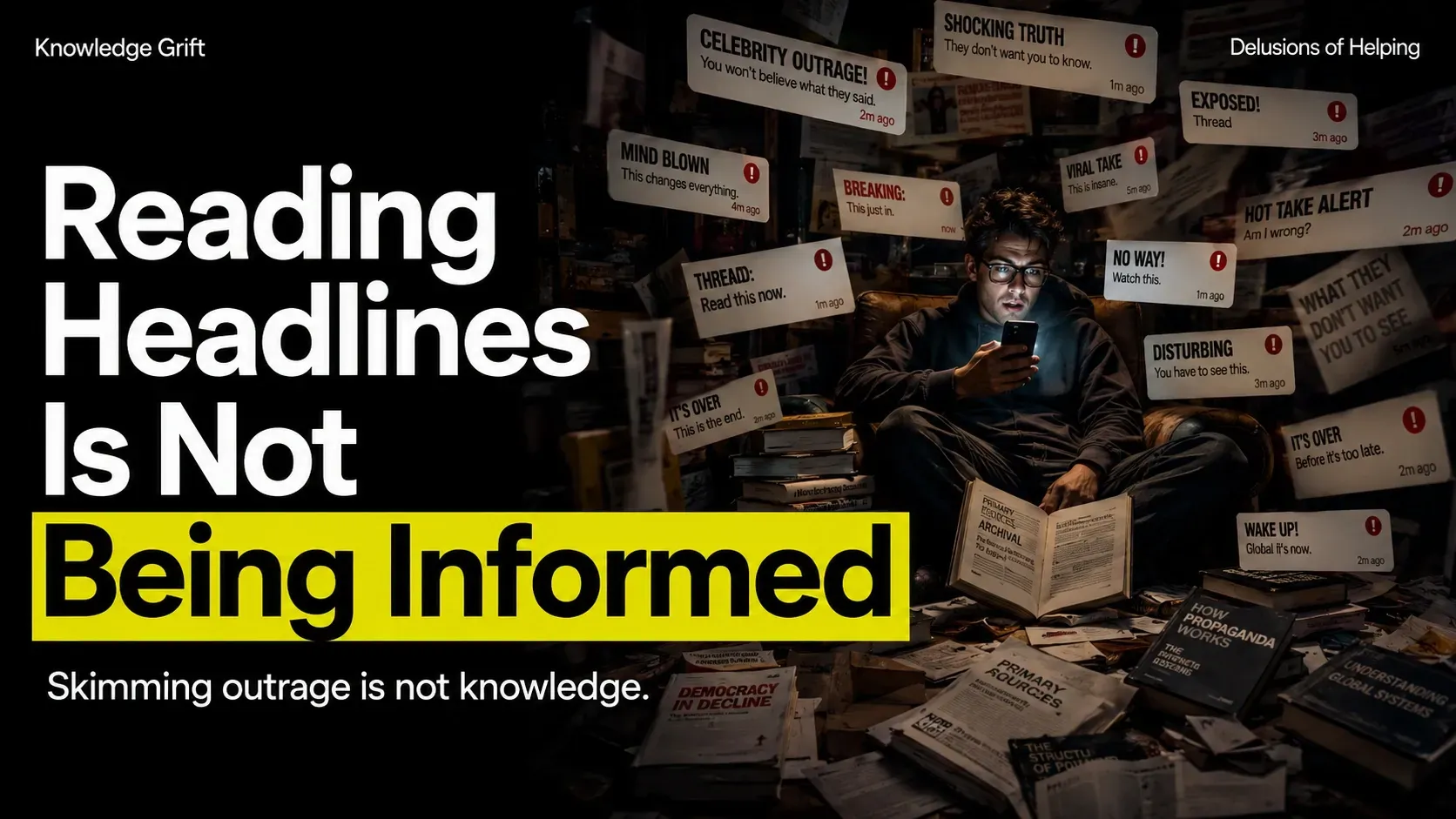
Reading Headlines Is Not Being Informed
A headline can tell you what to feel before it tells you what happened. Reading it is not the same as understanding reality.
By Chris Markl
Reading headlines is not being informed.
It is being introduced to a story by the most emotionally efficient sentence someone could sell you.
Sometimes the headline is accurate. Sometimes it is necessary. Sometimes it is the best possible compression of a real event. Journalism needs headlines. Readers need entry points. A serious public cannot read every full article, court filing, budget, study, transcript, audit, policy memo, and source document in the world before breakfast.
A headline is not knowledge. It is the invitation.
But a headline is not knowledge.
A headline is a doorway. It is framing. It is packaging. It is a promise, a lure, a weapon, a warning, a summary, or a trap. It tells you where to look. It does not prove you understand what you are looking at.
Modern media has trained people to confuse recognition with understanding. You see the headline. You know the topic. You know who is mad. You know which side is expected to cheer and which side is expected to panic. You know the approved emotional posture. You know whether the story belongs in the file marked corruption, hypocrisy, stupidity, danger, injustice, collapse, betrayal, progress, backlash, or vibes.
That can feel like being informed.
Often, it is only being activated.
This is one of the quietest failures in modern public life. People do not merely know too little. They often know the first sentence of too many things. They have headline awareness, not understanding. They know the public mood around a story, but not the evidence inside it. They know the scandal name, but not the mechanism. They know the villain, but not the timeline. They know the outrage, but not the tradeoff. They know the take, but not the facts.
The headline says a policy will help families. Did it?
The headline says a company is saving the future. Is it?
The headline says a study proves something. Does it?
The headline says the internet is furious. Should anyone be?
The headline says democracy is in crisis, the economy is booming, schools are failing, AI is transforming everything, a celebrity destroyed someone, a brand betrayed its values, a politician delivered a historic win, or a new report reveals what everyone must think by 3 p.m.
Maybe the story matters.
Fine.
Read past the spell.
Everyone claims they are informing.
Fine.
Prove it.
A useful headline should orient the reader toward reality. A manipulative headline orients the reader toward reaction. The difference is not always whether the sentence is technically true. Some of the most manipulative headlines are built from facts arranged to create the maximum emotional distortion with the minimum legal risk.
The words may be defensible. The framing may still be dishonest.
A headline can make something isolated feel widespread. It can make something complex feel obvious. It can make a partial fact feel final. It can make a bureaucratic update feel like a revolution. It can make a normal disagreement feel like a moral emergency. It can make a real problem feel like proof that your enemies are exactly as evil as you hoped.
That is why reading headlines all day can make a person less informed in a very specific way.
They become familiar with everything and grounded in almost nothing.
They know what is trending. They do not know what is true. They know what people are saying. They do not know what the evidence supports. They know what the algorithm has decided deserves emotional circulation. They do not know what deserves attention, patience, investigation, or action.
This is not a personal failure only. It is a design feature.
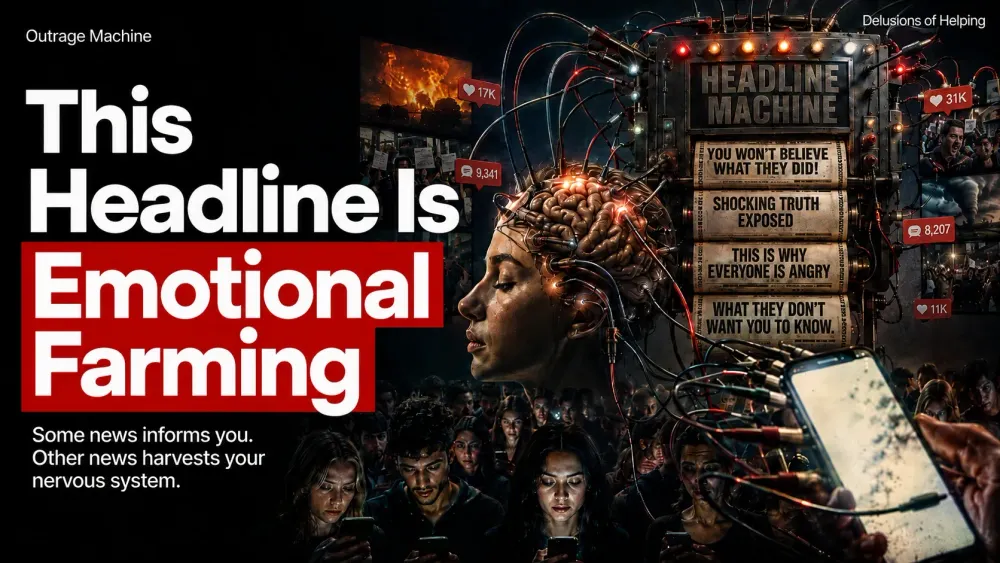
The headline economy rewards speed, certainty, conflict, fear, novelty, humiliation, and tribal clarity. A headline that makes you pause is often less valuable than a headline that makes you click. A headline that makes reality more complicated is often less profitable than one that tells you exactly who to blame.
The machine does not need you to understand the story.
It needs you to enter it.
That is how people become emotionally current and intellectually undernourished. They can discuss the controversy without understanding the issue. They can name the take without reading the evidence. They can join the reaction before knowing whether the reaction helps. They can mistake constant exposure to information for the slow discipline of becoming less wrong.
A serious reader needs a better standard.
Before letting a headline borrow your certainty, ask:
What actually happened?
Who says so?
What is known, and what is assumed?
What evidence supports the frame?
What context is missing?
What would the headline sound like if it were less profitable?
What would a smart opponent say?
Who benefits from my reaction?
What would change if everyone got mad?
What would actually help?
Those questions are not media snobbery. They are civic self defense.
A public that lives on headlines becomes easy to steer. It can be panicked, flattered, distracted, divided, monetized, and marched from emergency to emergency without ever becoming wiser. It can feel informed while becoming less capable of judging reality.
That is the real danger.
Not that people read headlines.
Everyone reads headlines.
The danger is when the headline becomes the whole mental event.
A healthier relationship to news would treat the headline as the beginning of a test, not the end of understanding. The headline says something happened. Good. Now what happened? What matters? Who is affected? What is being claimed? What is missing? What would improve reality?
Some stories deserve your full attention.
Some deserve a skim.
Some deserve skepticism.
Some deserve one quiet laugh and absolutely no additional nervous system involvement.
The point is not to read everything.
The point is to stop letting the first sentence decide your mind.
Reading headlines is not being informed.
It is only the invitation.
Accept fewer invitations.
Think harder when you do.