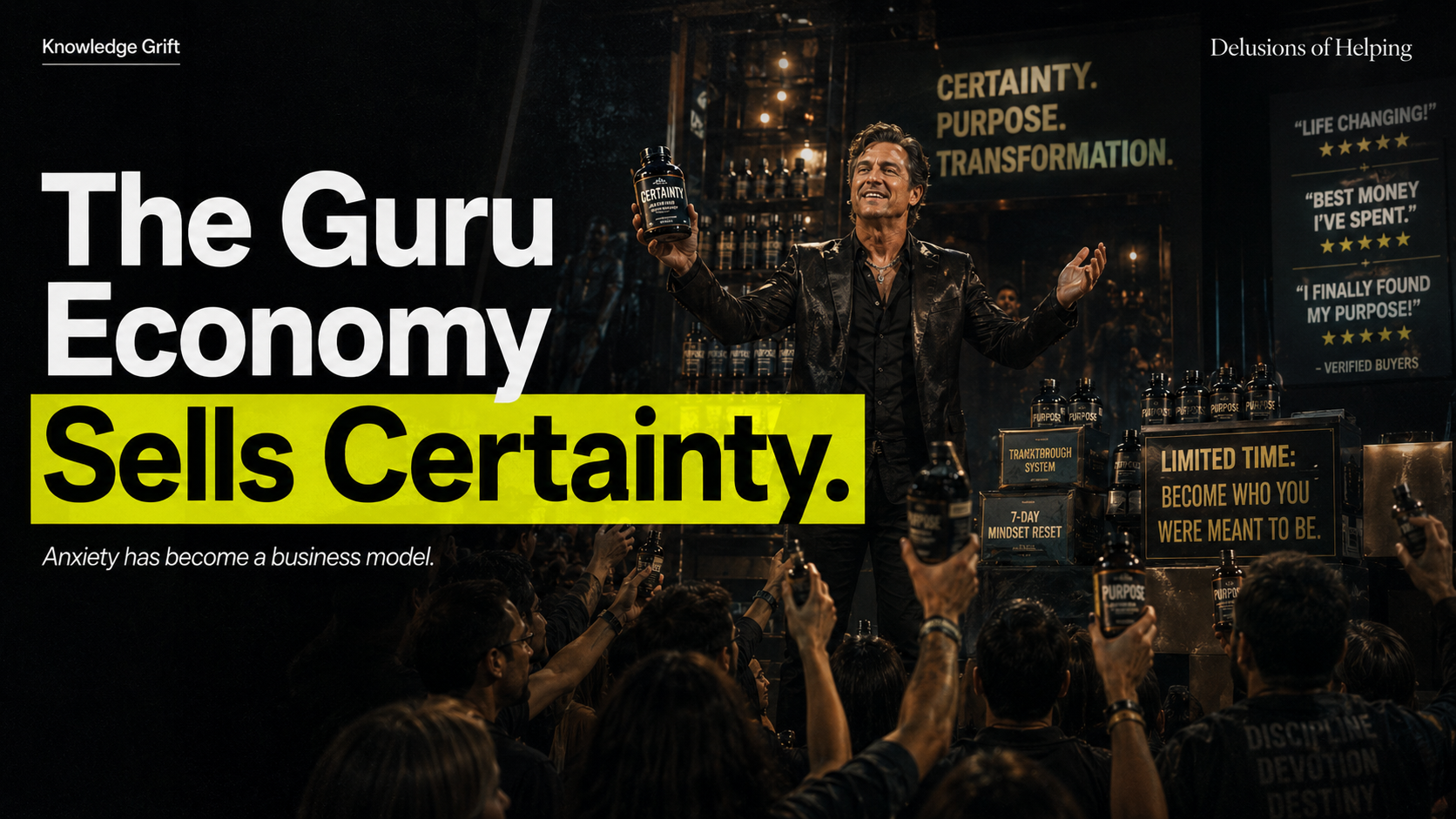
The Guru Economy Keeps Selling Certainty
The modern guru does not just sell advice. The modern guru sells relief from uncertainty.
By Chris Markl
The guru economy keeps selling certainty.
That is the product.
Not wisdom.
Not truth.
Not healing.
Not freedom.
Certainty.
A business guru says your problem is mindset.
A wellness guru says your problem is toxins.
A dating guru says your problem is masculine energy, feminine energy, attachment style, standards, trauma, hormones, polarity, confidence, or the fact that you did not buy the course.
A productivity guru says your problem is discipline.
A finance guru says your problem is school never taught you money.
A spiritual guru says your problem is vibration.
A political guru says your problem is the enemy.
A self help guru says your problem is that you have not become your highest self, which is apparently available through a seven step framework and a checkout page.
The details change.
The structure does not.
You are confused.
They are certain.
You are stuck.
They have the map.
You are wounded.
They have the language.
You are ordinary.
They have the transformation.
You are anxious.
They have the answer.
This is Knowledge Grift.
The modern guru economy thrives because life is genuinely hard. People are lonely, overwhelmed, indebted, unhealthy, under educated, over stimulated, professionally insecure, romantically confused, spiritually hungry, and exhausted by a world that keeps demanding performance.
That pain is real.
The market around it is enormous.
Where there is pain, there will be helpers.
Some helpers are good. Some coaches are useful. Some therapists are excellent. Some teachers change lives. Some writers clarify reality. Some mentors help people become stronger, calmer, wiser, more capable, and more honest.
Good.
But the guru economy does not merely help.
It converts human vulnerability into a scalable identity funnel.
First, it names your pain.
Then it explains your pain.
Then it tells you the world has lied to you.
Then it offers a framework.
Then it offers a community.
Then it offers a paid path.
Then it offers another paid path because transformation is apparently always one tier away.
The guru economy is brilliant because it sells people a feeling they desperately want: the feeling that life finally makes sense.
That feeling is powerful.
It is also dangerous.
Because certainty can become a drug.
Real growth often makes people more humble. Fake growth makes people more loudly sure.
Real wisdom expands complexity. Fake wisdom compresses everything into a slogan.
Real healing increases agency. Fake healing creates dependency on the person selling healing.
Real education teaches people how to judge. Fake education teaches people how to repeat the guru’s language.
Everyone claims they are helping.
Fine.
Prove it.
Did the follower become more capable?
Did they become more independent?
Did they gain judgment?
Did they improve relationships?
Did they become healthier?
Did they make better decisions?
Did they become less manipulable?
Did they gain the ability to function without the guru?
Or did they simply learn a new vocabulary for dependence?
That is the key test.
A good teacher should want students to outgrow them.
A fake guru needs the audience to keep needing the guru.
This is why certainty sells so well online. Platforms reward confidence. Nuance is slow. Humility is hard to package. “This is complicated and depends on context” is terrible for conversion.
“Here is the hidden truth they do not want you to know” performs much better.
The guru economy loves hidden truth.
Hidden truth makes the buyer feel special. It creates an inside group. It turns skepticism into proof that outsiders are asleep. It turns criticism into persecution. It turns doubt into weakness. It turns ordinary disagreement into evidence that the guru is brave.
That is how people get captured.
Not always by obvious cults.
Sometimes by content.
By daily posts.
By videos.
By captions.
By courses.
By frameworks.
By language that makes them feel seen while slowly narrowing their mind.
The guru does not need to control everything.
The guru only needs to become the person through whom reality is interpreted.
That is enough.
A healthier culture would be less impressed by confidence and more interested in outcomes.
Does the advice work?
For whom?
At what cost?
What does it ignore?
What incentives surround it?
What would falsify it?
Does it create agency or dependence?
Does it make people kinder, wiser, stronger, and more honest?
Or does it make them arrogant, fragile, performative, and permanently enrolled?
There is no shortage of people selling rescue.
There is a shortage of people helping others build judgment.
That is why the guru economy keeps winning.
It sells certainty to people who are tired of ambiguity.
But life is ambiguous.
Love is ambiguous.
Health is ambiguous.
Career is ambiguous.
Politics is ambiguous.
Identity is ambiguous.
Healing is ambiguous.
Purpose is ambiguous.
Any person who claims to make all of it simple should be treated carefully.
Maybe they have wisdom.
Maybe they have branding.
Ask for the receipts.
Did their helping help?
Did it make people freer, or did it simply give anxiety a subscription plan?