AI Slop Is the New Fake Knowledge Economy
The internet is filling with confident summaries, recycled takes, empty expertise, and synthetic certainty.
By Chris Markl
AI slop is the new fake knowledge economy.
It is everywhere already.
Generic articles. Recycled summaries. Empty explainers. Fake expertise. Content that sounds informed until you realize it has no judgment inside it. Polished paragraphs that say almost nothing. Social posts built from other social posts. Newsletters made from summaries of summaries. Search results filled with mush. Videos narrated by synthetic confidence. Guides that feel useful for six seconds before collapsing into obviousness.
The internet had a quality problem before AI.
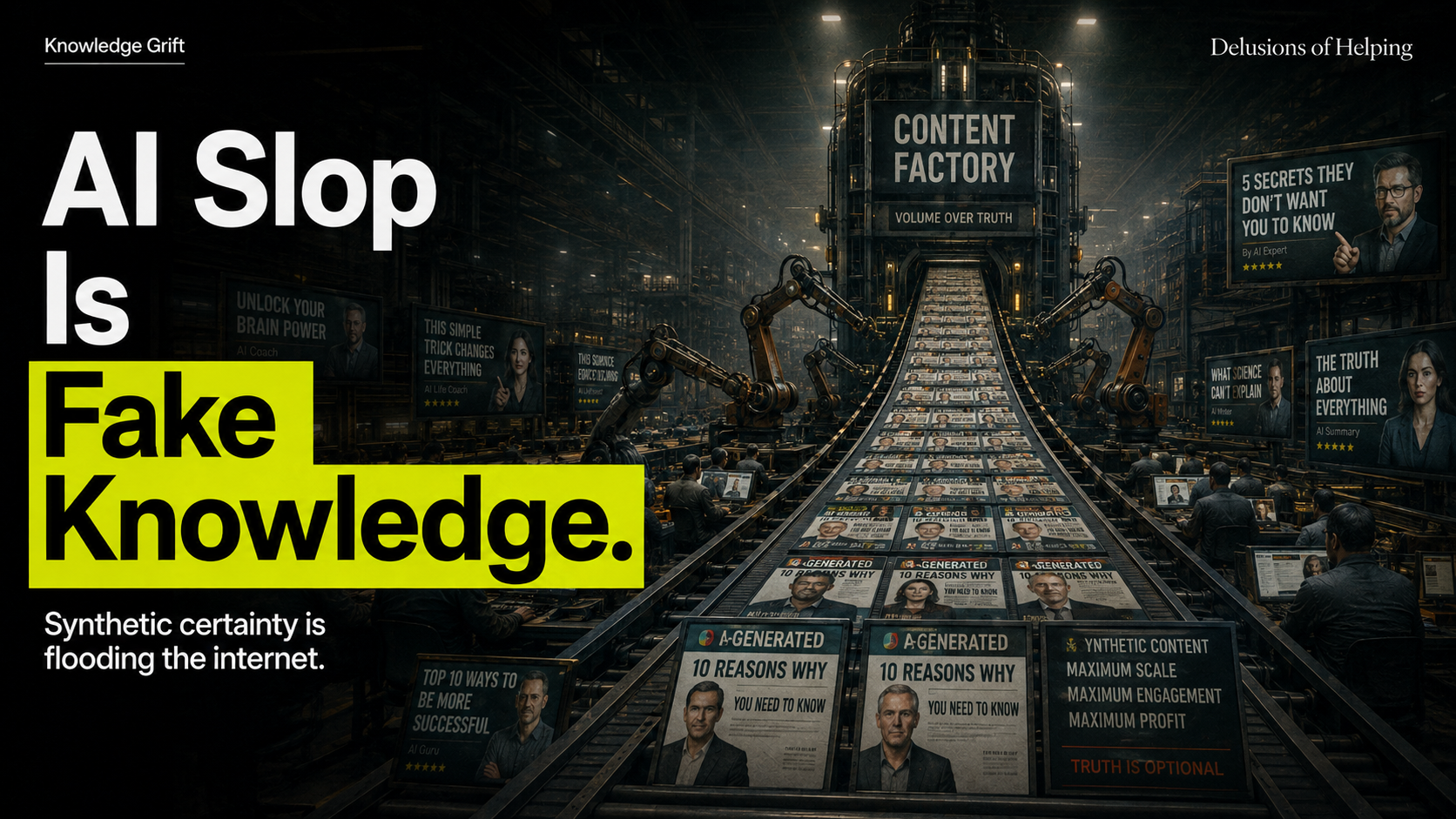
AI gave the quality problem a factory.
Now anyone can produce endless content that looks like knowledge from a distance.
That is the danger.
Not that every AI generated thing is bad. AI can be useful. It can help people write, research, organize, compare, analyze, brainstorm, translate, summarize, code, and create. Used well, it can expand capability.
But used lazily, it floods the world with pretend understanding.
AI slop is not just bad writing.
It is knowledge shaped material without knowledge discipline.
It has structure.
It has tone.
It has confidence.
It has headings.
It has phrases like “in today’s fast paced world,” “it is important to note,” and “the key takeaway.”
It feels complete.
But it often lacks experience, original judgment, hard questions, source discipline, taste, courage, specificity, humility, and contact with reality.
That is why AI slop is so dangerous.
It does not always look stupid.
It looks acceptable.
Acceptable is the new poison.
A bad article can be ignored. A weird article can be mocked. A false article can sometimes be checked. But acceptable slop quietly fills space. It answers the surface question. It satisfies the algorithm. It gives the reader something passable enough to stop searching.
Then the world becomes slightly dumber without noticing.
Knowledge Grift thrives when the appearance of understanding replaces understanding.
A student submits something that sounds like an essay.
A company publishes something that sounds like a thought leadership piece.
A consultant sends something that sounds like strategy.
A website posts something that sounds like journalism.
A creator shares something that sounds like analysis.
A guru uses AI to produce something that sounds profound.
Everyone is producing.
Almost nobody is thinking.
That is not an AI problem alone.
It is a human incentive problem accelerated by AI.
Platforms reward volume.
Search rewards coverage.
Social media rewards speed.
Businesses reward output.
Schools reward completion.
Marketing rewards visibility.
Audiences reward confidence.
AI makes all of that cheaper.
So the fake knowledge economy grows.
More content.
More summaries.
More explainers.
More takes.
More posts about posts.
More newsletters about trends.
More productivity theater.
More expertise costumes.
Less judgment.
Everyone claims they are informing.
Fine.
Prove it.
What did the reader understand better?
What was clarified?
What was tested?
What was sourced?
What was original?
What was uncertain?
What was missing?
What was the writer willing to say that the machine would not produce by default?
That last question matters.
Because the machine can produce fluency.
It cannot automatically produce courage.
It can organize information.
It cannot automatically know what matters.
It can mimic expertise.
It cannot automatically earn wisdom.
It can generate paragraphs.
It cannot automatically care whether they help.
The responsibility remains human.
A good AI assisted piece can be excellent if a real person brings judgment, standards, taste, research, experience, and accountability.
A bad AI assisted piece becomes slop when the person abdicates those things and lets the machine fill the void.
The future does not belong to people who can generate content.
Everyone can generate content.
The future belongs to people who can judge it.
What is true?
What is useful?
What is lazy?
What is missing?
What is manipulative?
What is merely plausible?
What has the texture of thought but none of the burden?
That is the new literacy.
AI slop is not going away. It will multiply because the incentives are too strong. Cheap content will fill every available gap. Institutions will use it. Marketers will use it. Students will use it. Media farms will use it. Fake experts will use it. Real experts will be tempted by it.
The only defense is judgment.
A serious knowledge culture must become less impressed by fluent output and more demanding of insight.
Do not ask only whether the writing sounds good.
Ask whether it knows anything.
Ask whether it risks anything.
Ask whether it clarifies reality.
Ask whether it helps the reader think better.
Ask whether a human being with standards was present.
AI can help create knowledge.
It can also mass produce the costume of knowledge.
That costume is everywhere now.
And it looks fine.
That is the problem.