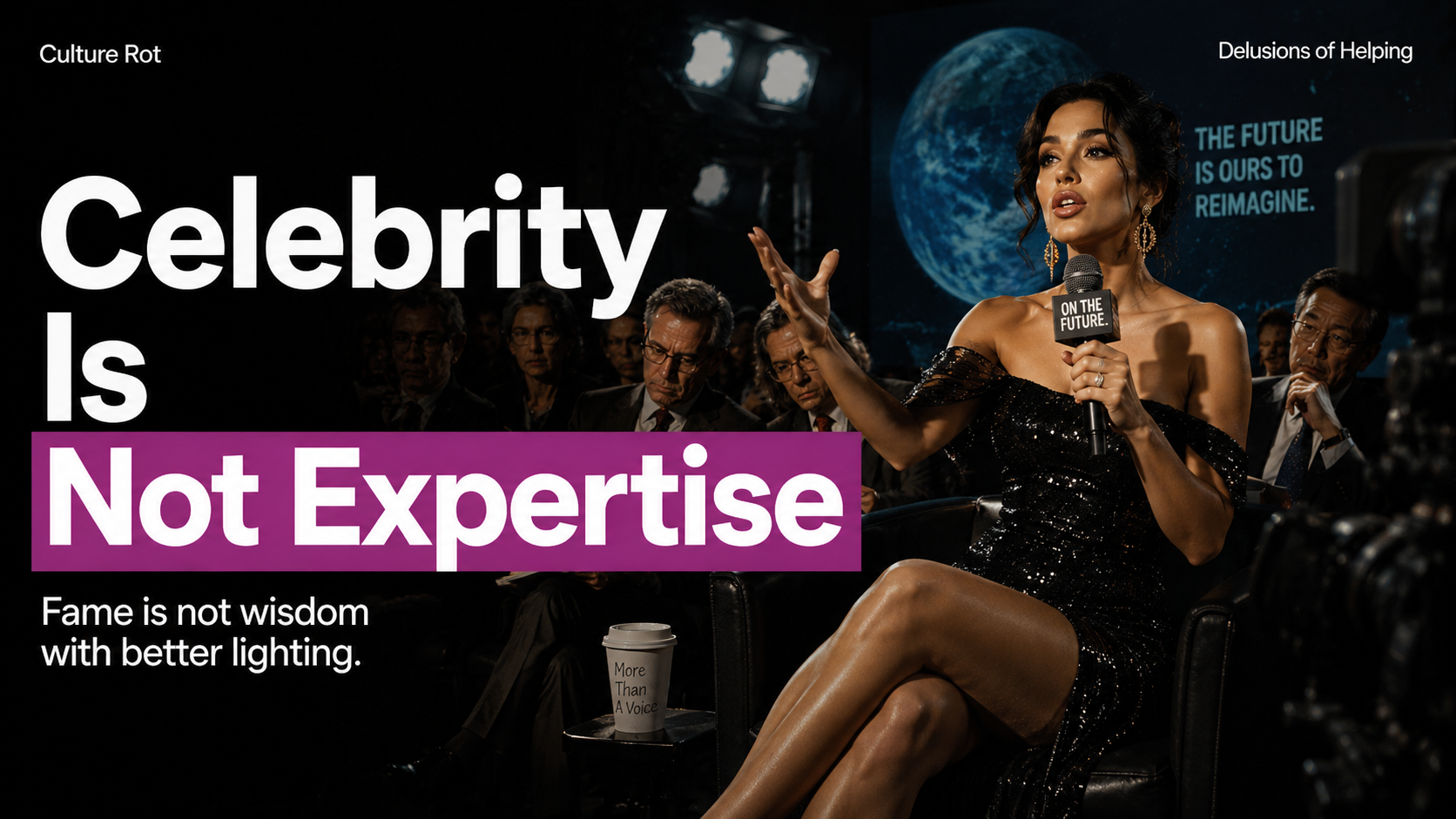
Celebrity Is Not Expertise
Fame is not wisdom. A large audience does not make someone a guide to politics, health, morality, or the meaning of life.
By Chris Markl
Celebrity is not expertise.
This should be obvious.
It is somehow not obvious.
A person becomes famous for acting, singing, dancing, hosting, fighting, modeling, playing sports, making videos, being attractive, being chaotic, being rich, being related to someone famous, marrying someone famous, or surviving the strange machinery of public attention.
Then, because millions of people know their face, society begins treating them as if they might also understand politics, nutrition, economics, parenting, mental health, geopolitics, spirituality, justice, education, public policy, masculinity, femininity, democracy, trauma, climate, medicine, peace, happiness, ethics, and the entire human condition.
This is insane.
It is also normal now.
Modern celebrity turns attention into authority.
That is the problem.
Attention is not knowledge. Fame is not wisdom. Charisma is not evidence. Wealth is not moral clarity. Beauty is not insight. A good performance is not a public philosophy. A hit song is not a theory of governance. A championship ring is not a sociology degree. A podcast microphone is not a temple.
Celebrities are allowed to have opinions. Of course they are. They are people.
Some are thoughtful. Some are generous. Some are intelligent. Some use their platforms responsibly. Some learn deeply before speaking. Some support causes that matter. Some contribute real resources to real work.
Good.
But the public should not confuse platform size with understanding.
The danger is not that celebrities speak.
The danger is that people listen differently because they are celebrities.
A normal person says something shallow and it disappears.
A celebrity says the same thing and it becomes discourse.
A normal person shares a half formed political thought and maybe five friends suffer.
A celebrity shares it and millions of people are invited to confuse emotion with analysis.
A normal person recommends a product and it is a recommendation.
A celebrity recommends a product and suddenly the thing has aura.
This is Culture Rot.
Not because entertainment is bad.
Entertainment can be beautiful. Sports can be thrilling. Music can save a day. Movies can reveal truth. Comedy can puncture arrogance. Art can make life more bearable.
The rot begins when entertainment becomes a substitute for judgment.
A culture that cannot distinguish fame from wisdom becomes easy to manipulate.
Brands understand this. Campaigns understand this. Platforms understand this. Nonprofits understand this. Movements understand this. Every cause wants a famous face because attention is scarce and celebrity is a shortcut.
That shortcut may help.
But it may also cheapen the work.
A serious issue becomes a caption. A complicated policy becomes a slogan. A suffering population becomes a backdrop. A movement becomes a red carpet accessory. The celebrity receives moral credit for caring. The public receives an emotional cue. The people supposedly being helped may receive very little.
Everyone claims they are helping.
Fine.
Prove it.
Did the celebrity campaign change policy?
Did it move money to effective work?
Did it improve the lives of the people being discussed?
Did it educate the public accurately?
Did it amplify people with real knowledge?
Did it reduce harm?
Or did it mostly create a content moment where everyone felt briefly moral before moving on?
That is the test.
This also applies to the new celebrity class: influencers, founders, podcasters, gurus, streamers, commentators, athletes, creators, and people who became famous because the algorithm found their face profitable.
They may know something.
They may know nothing.
The audience has to judge.
The fact that someone is confident does not mean they are correct. The fact that someone is vulnerable does not mean they are wise. The fact that someone uses therapeutic language does not mean they understand healing. The fact that someone says “do your own research” does not mean they have done any.
A healthy culture can enjoy celebrity without obeying it.
Watch the movie.
Play the song.
Cheer the athlete.
Laugh at the comedian.
Admire the talent.
Then remember: talent in one domain does not automatically transfer to authority in another.
Celebrity should not be a priesthood.
A famous person can entertain you.
They can inspire you.
They can occasionally teach you something.
But they cannot do your thinking for you.
That job remains yours.